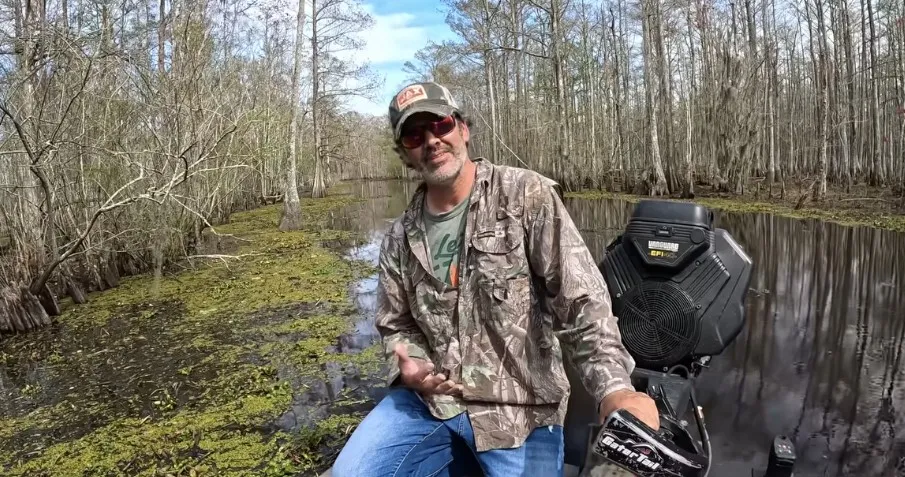
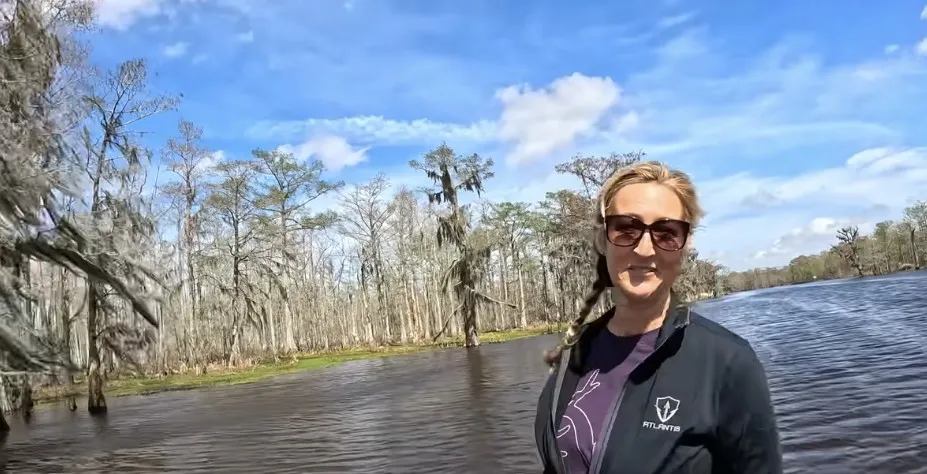
I’d come because I was curious about what drives someone to live in a swamp. The flat-bottomed boat nosed through the murky water like an alligator. At the tiller, Keith steered with the confidence of a man who’d run these channels since boyhood, his camouflage style and mirrored sunglasses screaming summer of ’87. Tara sat up front, loose strands of blonde hair breaking free from her braid in the cool wind.
We were slinking through the edge of the Atchafalaya Basin, the largest river swamp in the United States. It’s about an hour and a half west of New Orleans, Louisiana, where the French Quarter had been restless the night before, with partying tourists and jazz bands. I’d heard Pierre Part (population: 3,000) was about as Cajun as you could get; that it was the most French-speaking town in the US outside a village in Maine. And so that’s where I’d headed.
Out here on the water, the landscape reminded me a bit of the Florida Everglades: an overgrown, labyrinthine place for die-hards and outlaws. A last frontier feeling. This was a place for people who wanted to chart their own course in some downright hostile conditions. I’d come to Pierre Part to meet a couple who’d decided that their American dream was to live part-time in a one-room wooden houseboat on a swamp.
Keith motored us around town a bit, passing porches, docks, weathered houses set close to the water. Pierre Part was essentially an island — a long stretch of high ground surrounded by wetlands. Tara pointed out landmarks. Her grandparents’ house. The street where her stepmom grew up, and her parents before her, and their parents before them. It felt like moving through her family photo album. “This is the end of the road,” Tara said as I looked at the last house on the bank. Everything from here was by boat.
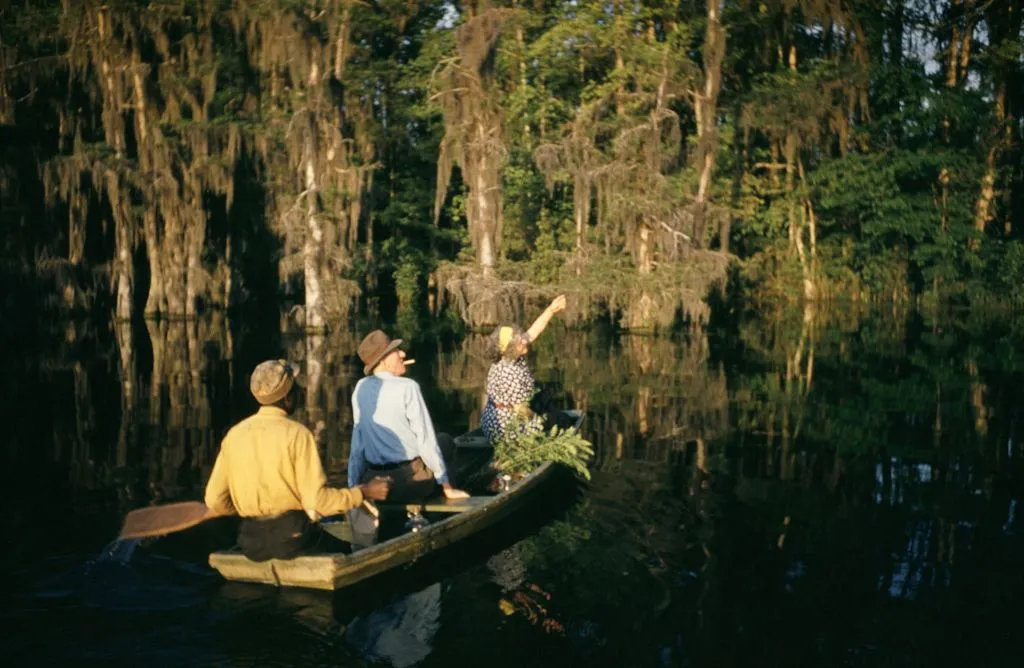
For a stretch it was nothing but open water, brown and opaque. A faint stagnant odour came off the surface. Along the shore, the cypress trees blurred into a solid brown-green wall until little dark cuts began to show. “We call ’em a bayou run,” Keith hollered. “There’s a maze of ’em, just like trails in a forest.” He steered left into a narrow channel. It felt a little mysterious, a separate ecosystem that could only be accessed through local Cajun knowledge. Here and there houseboats appeared along the bank.
In the distance, I noticed a man sitting on the small porch of a grey cabin. “Who are you, and what are you doing on our houseboat?” Tara called out. She had this fantastic accent, a Southern drawl with a touch of French that carried a playful ease.
“I’m the boogeyman!” The man smiled.
Tara burst out laughing. “That’s my dad,” she said. “He’s 82.”
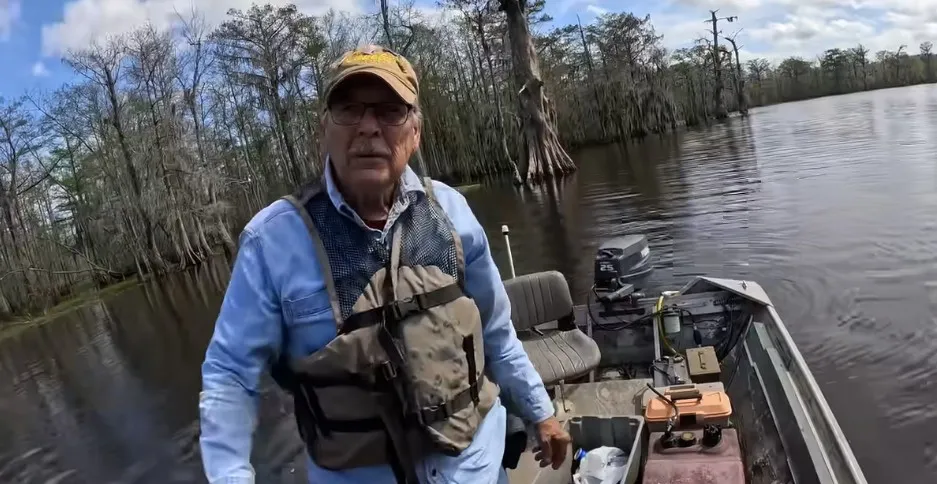
We floated closer. Tara climbed up to tie the rope around the porch post. Her father looked no older than 60 — lean and upright in a faded denim shirt and cap.
“How are you doing, sir?” I asked.
“I’m doing,” he said, reaching out his hand for a shake. “Carlis Goday.” In his Cajun accent, the weight landed on the second syllables.
“The man without a car, Car-less. Last name’s Go-day. If you can’t go nights, you go days.”
Tara gave me a little tour of the house, which looked no bigger than 250 square feet. “This is the kitchen.” She pointed to the propane four-burner stove in one corner, a single counter opposite, and a roll-out grill wedged between. “Keith does all the outside cooking, I do the inside. We haul this grill out onto the porch just to give us more room in here.” The rest of the room was simple: a bunk bed, a futon folded into a couch, life jackets, tools. Fishing gear in organised piles. A flatscreen TV and an enclosed bathroom with a toilet were the only luxuries. A small sign nailed to the wall read BORN TO FISH, FORCED TO WORK.
Come summer, Keith told me, the bayou turned into a playground: waterskiing, hydrosliding, wake-boarding, swimming in clear pockets before the water thickened to pea green. “The snapping turtles you gotta be wary of, they can really bite,” Tara warned.
“We’ve got a swimming spot we love, even with alligators everywhere.” She smiled at my wide eyes, as if living a few feet above alligators was the most natural thing in the world. “The bigger alligators are usually shy,” Keith added. “The smaller ones, you can get closer to, but they won’t mess with people. They like swimming up to our dock when we’re cleaning fish or frogs. But out here they don’t really bother us. I think they had maybe two deaths in Louisiana since, I don’t know… hundreds of years.”
The Cajun story didn’t start in Louisiana. It began along the coast of the rugged western edge of France, a Celtic stronghold of sailors and pirates who started crossing the Atlantic in the early 1600s, settling in what was then the young French colony of Acadia and is today Nova Scotia, New Brunswick, and Prince Edward Island, Canada. Here, the Acadians lived the way they always had: close to the water, close to family, close to the Catholic church. They turned salty tidal marshes into farmland, wove their own clothing from flax, and — stubbornly — made a living 3,000 miles from home.
But it wasn’t to be. Acadia was in turbulent territory. The Acadians wanted to remain neutral between Britain and France, but when the British defeated the French, the Acadians were pushed to swear allegiance to the British Crown. They refused: their loyalty was to God, not to European empires. That defiance came at a cost, and in 1755, the British forced them out in what became known as the Great Expulsion. Villages were torched, families torn apart, thousands deported. Many died from disease and starvation. No documents written by Acadians during this period have ever been discovered, and so the expulsion remains as much myth as heritage to the people of Louisiana (who love both myth and heritage).
Some Acadians ended up back in France, some scattered through the British colonies, and others drifted to the Caribbean. Those who came to Louisiana — still a French colony in those days — found something familiar. The prairies and swamps reminded them of home, only warmer. Difficult enough to live on that few bothered them and fertile enough to survive, especially with the help of Native nations like the Chitimacha, Atakapa, and Houma living along the Gulf Coast.
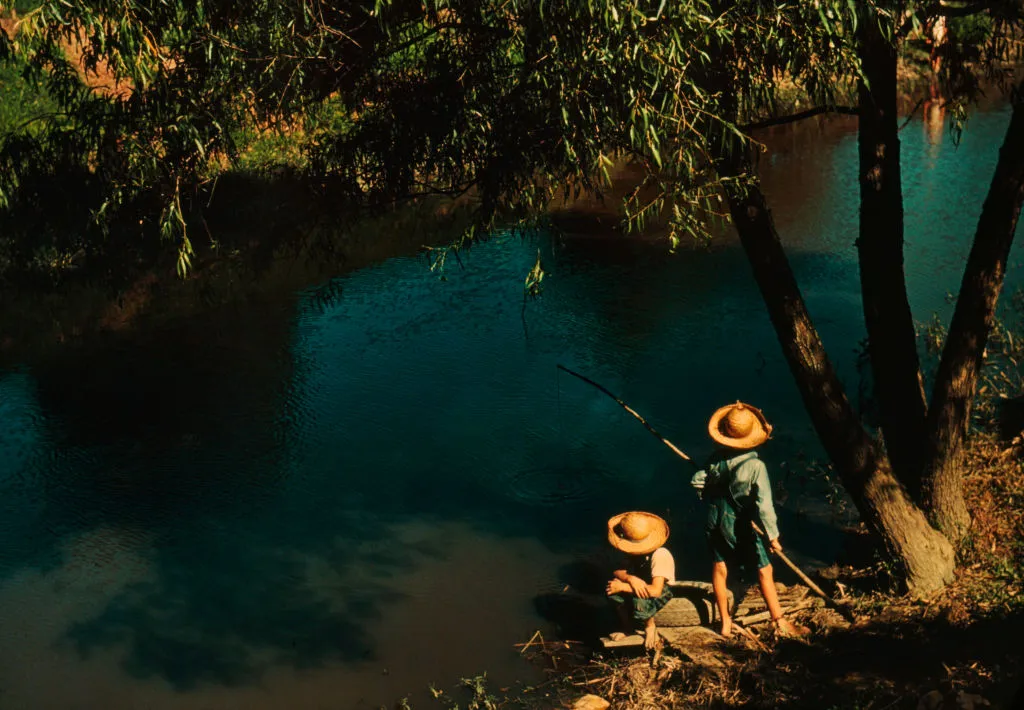
Cajun French includes many Native-derived loanwords — even the term bayou, from the Choctaw word bayuk (“small stream”). In time, the groups began to intermarry, encouraged by proximity and shared hardships, and Cajun food developed from indigenous smoking methods, ways of preservation, and seasonings. The Cajun staple filé powder, made from ground sassafras leaves, comes from the cooking traditions of the Choctaw and related Gulf Coast tribes.
The story of black influence in the bayou runs just as deep. Many enslaved Africans sought refuge in the wilderness, forming Maroon communities hidden along the swamps. Some of them lived independently; others mingled with Native tribes and Cajun settlers. Gumbo’s okra-thickened broth has African roots, a stew of cultures that’s simmered for hundreds of years. As time passed, Acadian slurred into Cajun. But the backbone of the culture stayed the same: make your own way, stay close to your people, adapt to whatever the land throws at you.
Carlis Goday wasn’t born on the bayou.
“I was raised in the French Quarter in my younger years,” he was telling me as we stood around on the deck.
“What do you think it’ll be like in 20 years out here?” I asked him. “You think it’ll stay the same?”
“No, no.” Carlis said it with vehemence and without hesitation. “Things are changing too much. Too much erosion.”
Hurricanes were tearing up so much that there was nothing left to hold the land together but tree roots, while they pulled in salt water that killed off grasses, hastening the decline.
“Everything’s going,” he said. “Everything’s washing away. But this” — he pointed down at the water beneath the porch — “This was built when they put in some oil rigs back here.”
“Oil rigs?”
“Most of the man-made canals were from the oil companies,” Tara explained, cut as inroads for drilling rigs and pipelines, as well as drainage. “That’s the big industry out here, oil and gas.”
Big enough to employ them both. Keith did maintenance for offshore platforms, Tara was a materials coordinator. It seemed like they had things figured out: one foot in the swamp, the other in capitalism, providing the financial security that let them live by the rhythms of the natural world. A yin and yang approach.
Keith trolled slowly, deeper in, scanning through tree trunks to the left of us. Things got quiet, and he looked serious for the first time, like he’d switched into survivor mode.
“Hoping to go find a big nutria rat to show you,” I heard him say.
“Nutria rat?”
“Very invasive around here. They tear up a lot of these marshlands. They’ll eat all the roots of the vegetation, dig holes in levee systems. A lot of people trap ’em for the tails. Certain times of the year you can trap the nutrias, and they’ll give you $6 a tail.”
“It’s a government programme,” Tara added.
“We actually shot a few last weekend — and we ate ’em.”
“You eat ’em?” I said, probably failing to hide my shock.
“They’re actually a very clean meat. They’re vegetarian.”
“How many pounds are they?”
“Oh, they can get five pounds to probably up to 20.”
“They’re like midsize dogs?” The image in my head wasn’t getting any prettier.
Keith laughed. “I’m-a show you some in a few minutes — you’re gonna see. New York, they don’t have anything on us in rats.”
The boat slowed, the motor humming just enough to push us along. “They hear the motor and take off running,” Keith said, scanning the shallows. “But a lot of times if you just kind of creep up on ’em, they’ll sit in the lilies or in the marsh and eat grass.”
Suddenly Keith’s posture shifted. He cut the motor and reached for the rifle on the floor of the boat in one swift motion, chambered a round without taking his eyes off the forest, and raised the barrel. A click. Then the sharp crack of gunfire split the quiet, echoing through the trees.
“Oh, I heard it,” Tara said. “That was a good shot.”
The motor coughed back to life, the boat gliding towards the bank. Keith hopped out and slipped into the undergrowth. I followed. He must have been 100 feet away from shore when he finally crouched down to the ground. Then he straightened, pulling up a long, limp brown body by its slick 10-inch tail.
He was holding a wet, shaggy nutria, its long orange teeth jutting like chisels. Its webbed feet dangled in the air, black claws curled tight at the ends. Something between a beaver and a rat, and ugly as sin.
“That’s a small one,” Keith said, raising it high for Tara to see. “My friend calls ’em swamp bunnies.”
“And that’s part of the dinner menu tonight, right?”
“Would you like to try?”
“I mean, if you’re doing it… when in Rome.”
“We could try frying it,” Tara suggested.
“Ah…” Keith considered it for a moment. “I think a nutria stew would be awesome.”
I’ve often heard people say that America has no culture, and I think that claim couldn’t be more off. Sure, America doesn’t have one neat, homogeneous culture — it’s too mixed, too big, too complicated for that. What it does have is a whole host of cultures sprinkled across its vast and beautiful geography. That’s the true gift of this country: you can choose the life you want to live, in the culture that feels right to you.
And the beauty is that so much of America still stands with its arms open. If you show up somewhere as an outsider, and take the time to respect how people live there — not trying to change them, not trying to prove that where you’re from does things better — you’re usually met with real warmth. Come in curious, ask questions, listen more than you talk, and try to understand where people are coming from, and wow, it’s a beautiful thing.
For Keith and Tara, I was realising that it was the unpredictability of life out here on the bayou that’d become the attraction. Keith had told me the biggest threat of living here was the storms — hurricanes blowing 160 miles an hour for hours on end, floods rising fast and rolling through without mercy. Looking out at the still water all around us — the soft wind rustling the moss in slow sways, chorus frogs peeping from the banks — it occurred to me that the risk of living here was that one moment, the place gives you peace, but the next it could strip everything away.
I try my best to see things from the perspective of the people I’m meeting up with, because I’m always curious how others see the world. Out here, I could feel the comfort that comes from knowing your immediate survival doesn’t depend on supply chains or policies but on your own skills and relationships. Keith and Tara were as connected to their food source as you can get. Swamp-to-table cuisine.
“So, say the grid goes down,” I said. “Everything stops — no cell coverage. You guys are fine out here?”
“Yeah,” Tara said, no hesitation.
“We’re gonna be fantastic,” Keith said, a wide smile spreading across his face.
“Fuel and clean water would be the tough ones to get, though?”
Keith glanced at Tara, as if checking that they were on the same page. “Yeah, but there’s ways to get clean water. We’d boil it all day long if we got to.”
“And how many rounds of ammo at the house?” Tara asked.
“Ooh . . .” he paused, trying not to look too pleased with himself. “Eighteen thousand rounds, maybe.”
“You’re getting ready for something, Keith?” I asked with a grin.
“Always,” Tara cut in, laughing.
Keith didn’t answer me on the fuel question since, of course, without fuel, all of this stopped: the motorboat, the cooking stove, the backup generator. It’s romantic to imagine making it in the wild on our own — and Keith and Tara could do better than most. But the truth is, we’re all dependent on civilisation; it’s just a question of degree.
“What do you guys feel about the rest of the country out here?” I asked.
“I watch no news. None,” Keith said. He sounded proud. Defiant.
Tara leaned forward with a small laugh. “We haven’t watched the news in years.”
“I used to keep up a little bit,” Keith said, “and it would just upset me so much to see all the stuff going on. So I was like, ‘You know what? I’m a lot happier, honestly, not keeping up with it.’ ’Cause how much positive stuff do you see in the news?”
“Nothing,” Tara said quickly.
“So this is what we do” — he looked around — “and we enjoy our lives doing it. And if we’re not here, we’re doing stuff with our families. For Christmas, you’re probably looking at 60 to 70 of just my family. People like to get together here. You do a crawfish boil, and you just tell everybody, and they bring a dish, and everybody just has a great time.”
Soon the houses came back into view. I spotted Carlis sprawled on the dock napping. Afternoon sunlight warmed the wooden planks, the soft whistle of a cardinal carrying across the water.
“I got you a treat,” Keith said, dropping the nutria at his father-in-law’s feet. “You want some nutria stew?”
Tara set a heavy iron pot on the stove, rice and onion sizzling as Keith busied himself with the day’s catch. Carlis lifted a bottle: homemade wine, wild muscadine from the swamp, generations of craft bottled inside, stretching all the way back to his ancestors in France.
“Tara, can you bring me that gut bucket in the back?” Keith called out. “The white one we found earlier?”
Tara wrinkled her nose and looked at me. “I know, that sounds so gross, huh?”
Carlis cracked the bottle of muscadine open and tipped it forward, the deep red liquid glugging heavily into a white Styrofoam cup. He lifted it under his nose and breathed deep. “Aah. Tolé, ça c’est bon!”
A little Bordeaux in the bayou, I thought.
“Do you feel the Cajun culture’s under threat at all?” I asked as he took a slow sip of the wine.
“We’re losing it,” he said. His face tightened at the thought.
“Back when I was little, just this area here, I’d say 100% of the kids spoke French. Nowadays, you’re lucky if you get 25% to 30%. Just like my grandkids. They understand it, but they never wanted to talk it.”
“But you spoke it ’cause your parents made you speak it, right?”
“They didn’t make me — that’s all we had. French was my first language. In school, they made us quit talking French.”
“So the US school system didn’t want any French being spoken at all?”
He shook his head. “And then just lately, the last few years, they started with French immersion — teaching French.”
“Language is like a tidal wave,” I said to Carlis. “It’s hard to go against.”
That was how it went, the pendulum swinging from pushing out French influence to embracing it again. Starting in the late 1800s, you could see the pressure to make Louisiana less French in all kinds of small, telling ways — French street names anglicised, public institutions phasing out the language. Catholic parishes were reorganised, some priests replaced with English-speaking clergy. And yet, for all the pressure to “Americanise”, the culture held on. Children still spoke French at home, even if they were punished at school for it. Music carried the language when conversation couldn’t. Recipes travelled from grandmother to grandchild. What survived did so stubbornly, underground at times, until the Sixties, when the cultural revival movements — Cajun music festivals, immersion programmes, the creation of a state agency for Francophone Affairs — began bringing the language and traditions back into the everyday. But the reality is that kids will speak the language that’s cool with their friends, the language of the TikTok videos that they’re watching.
Over in the kitchen corner, Tara lifted the black pot’s lid as the stew roared, a rush of steam and bubbling, rich and heavy. She leaned into the cloud, breathing deep, satisfied.
Plates in hand, we stepped outside to eat in the open air. I lifted a forkful. “All right,” I announced, almost ceremonially. “My first nutria.”
I was on my toes. Food can be such a big part of identity that the rejection of a meal can seem like the rejection of a culture. I took a big bite and chewed on it for a moment. It wasn’t bad. Earthy, dense, close to rabbit or dark chicken meat.
“It’s like nothing I’ve had before, to be honest,” I said. “Texture’s like…” I hesitated. “Gummy. A lot of flavour. It’s got some kick to it, right?”
Keith leaned closer. “Big question is — would you eat it?”
I smiled, swallowing. “If I was out here, yeah.”
They both laughed.
This is an edited excerpt from Your Fellow Americans by Peter Santenello. Copyright 2026 © by Peter Santenello. Reprinted by permission of Simon & Schuster, an Imprint of Simon & Schuster, LLC.
Peter Santenello is an independent journalist and filmmaker with over four million subscribers on YouTube. He’s travelled to 85 countries and lived in five.