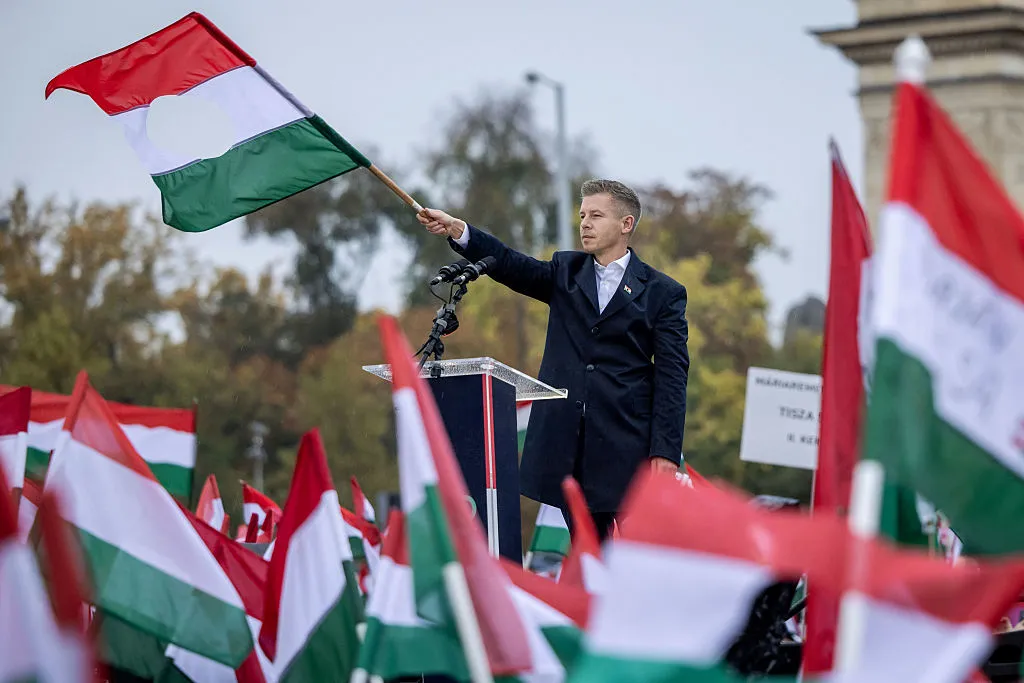
Operation Purgatory. It sounds like a Pete Hegseth fever dream. In fact, it’s Péter Magyar’s name for his assault on the Orbán system and all its works. Blending legislative and administrative measures, the cornerstone of the new Hungarian government’s offensive is a vast constitutional overhaul: a series of sweeping amendments to Hungary’s so-called “Fundamental Law”, designed to destroy what’s left of the ancien régime — and ensure it can never return to power.
The most consequential provision is without doubt the 16th Amendment to the constitution, which imposes a lifetime term limit of eight years (two parliamentary terms) on the prime minister. Effective retroactively, the measure is obviously targeted at Viktor Orbán. Given he’s already served for a total of 20 years, the new law bars him from ever returning to office. Quite apart from its nakedly ad hominem character, which critics have already dubbed the “Lex Orbán”, the provision has no defensible logic. Why should voters be prevented from re-electing a leader, or rather a parliamentary majority that supports him, if they choose to do so? Indeed, virtually no parliamentary democracy — where, unlike in presidential systems, executive power is shared with a cabinet and remains fundamentally dependent on maintaining a parliamentary majority — imposes a term limit on the head of government.
But the new government didn’t stop there. Another provision, the 17th Amendment, sets a 12-year term limit for members of parliament. Again the ad hominem — or in this case ad partem — nature of the law is clear. Conveniently, no sitting MP from Magyar’s Tisza Party is affected: only the opposition. Fidesz and its allied party KDNP, having dominated frontline politics since 1990, stand to lose their entire senior cadre. One might call this Lex Fidesz, though other parties are caught in the net as well. The blow falls equally hard on the political Left, disqualifying most of its veteran figures and rendering a progressive resurgence all but impossible.
Equally striking is the manner in which the new government ousted the incumbent president, Tamás Sulyok, who had been elected by the previous parliament in February 2024 and whose term was supposed to run until 2029. Magyar, who accused Sulyok of being an Orbán puppet, targeted him from the moment of his victory speech and did everything possible to force him to resign. When Sulyok refused to step down, the new government could have initiated an impeachment procedure, the only mechanism for removal provided for by the Fundamental Law.
Instead, Magyar chose simply to slip a line into one of the constitutional amendments which literally reads: “the term of office of the incumbent President of the Republic terminates today”. Meaning: removal by legislative fiat, what we may call Lex Sulyok. Even Amnesty International Hungary criticised the constitutional coup aimed at unseating the president. It is worth noting that Sulyok also appealed to the Venice Commission, the Council of Europe body that advises states on constitutional and rule-of-law questions, to review the amendment. The Commission’s reply, following a brief trip to Hungary? That it would rule on his motion at its next plenary session in October, neatly coming months after his removal.
The judiciary has not been spared either. Magyar’s 17th Amendment reintroduces a mandatory retirement age of 70 for Constitutional Court judges, effectively removing the chief justice and three other judges, and handing Magyar the opportunity to flip the political balance of the court within his first term. The same amendment further establishes a new body, the National Office for Asset Recovery and Asset Protection, tasked with “the tracing and recovery of public assets that have been unlawfully managed or used” by the previous government. Creating a body to investigate alleged corruption might not seem particularly nefarious: until one realises that Hungary, like every European country, already possesses institutions devoted to precisely this purpose.
The Ukraine war's big lie
What makes this one unique is that it’s charged solely with investigating the alleged wrongdoings of a single party — Fidesz — outside judicial and societal oversight. As András Schiffer, the former leader of the green party LMP, put it, the body’s aim is to “make it morally impossible for Fidesz to compete through a series of trials — spiced with staged theatrical performances — and inquisitorial proceedings”. The new government’s decision to join the European Public Prosecutor’s Office (EPPO), itself a highly politicised body effectively operating under the Commission’s control, will only reinforce this.
Magyar has defended these actions by invoking “the exceptional mandate received from the electorate” and as a “precondition for the restoration of constitutional democracy”. The new prime minister’s argument is simple: since Orbán created a “mafia state” that trampled the rule of law, its restoration requires the complete destruction of the Fidesz system. The constitutional amendments, indeed, are only part of a much wider offensive, which includes shutting down the news output of the public media; closing Fidesz-aligned cultural institutions such as MCC and the Danube Institute; and launching a judicial raid on the offices housing Fidesz’s servers to seize its databases, taking the party’s website offline (it still is at the time of writing). For their part, Orbán and his party have accused the new government of dismantling the rule of law, eliminating the system of checks and balances, and persecuting the opposition — of creating, in essence, precisely the authoritarian regime that the liberal establishment always accused Orbán’s government of being.
My purpose is not to convince you that Orbán is right. It is rather to reflect on what the post-Orbán transition tells us about the vanishing meaning of words like “rule of law”, “democracy” and “tyranny” in our post-everything age — and to highlight some of the contradictions within both the liberal and the Orbán camps.
Let us start by clarifying that, technically speaking, the new government’s measures are not illegal. Post-communist Hungary has always been defined by what might be called a hyper-parliamentary system: simply put, a government with a two-thirds majority can amend the Fundamental Law, or even replace it wholesale, in a single chamber, in a single vote, without facing any substantive review by judges. A two-thirds majority also controls the so-called “cardinal laws” — electoral rules, media, judiciary, central bank — and key appointments like constitutional judges and the prosecutor general. The Hungarian parliament thus faces far fewer obstacles in its legislative functions than most of its European counterparts, where constitutional revision tends to require multiple votes, referendums or even general elections. In Germany, certain constitutional fundamentals are outright unamendable — permanently beyond the reach of any parliamentary majority, no matter the size. In Hungary, by contrast, a government with a two-thirds parliamentary majority faces effectively no institutional veto at all.
Von der Leyen is coming for Europe’s wallet
Orbán himself mastered this institutional logic better than anyone before him — and in fact reinforced it after 2010, severely curtailing the Constitutional Court’s power to review constitutional changes. The following year, Fidesz then used its own supermajority to adopt an entirely new constitution, redefining the country’s constitutional identity in explicitly national-conservative terms. From there it expanded the court from 11 to 15 judges, handing itself the opportunity to immediately pick four new justices, even as it consolidated a powerful pro-government media machine.
In this sense, you can argue that Magyar is simply following the democratic logic established by Orbán: that a government with a strong mandate should be free to implement sweeping changes that reflect the popular will, and use its constitutional majority to entrench the ruling party’s political interests. Somewhat ironically, Tisza itself benefited from Orbán’s 2011 electoral reform, which raised the share of single-member constituencies from about 45% to 53%, boosting the majoritarian, winner-take-all component of the system. As a result, Tisza’s 53% of the vote translated to roughly 71% of seats. Certainly, Fidesz’s accusation that Tisza is “dismantling the rule of law”, “eliminating the system of checks and balances” and “destroying the legitimacy of independent institutions” rings rather hollow — even as it mirrors the accusations the EU establishment directed at Orbán for years.
All the same, it is true that Tisza has crossed red lines that Orbán never dared to cross: no previous government, for instance, had ever ousted a sitting president by decree. In this sense, some of the new government’s actions, while not technically illegal, undoubtedly violate well-established constitutional principles — such as the inviolability of the president.
But are we sure this is a principle worth defending from a popular-democratic perspective? Setting aside the specifics of the Hungarian case for a moment, the reality is that many of the “independent” institutions that make up the edifice of modern liberal democracies — presidential offices, independent central banks, constitutional courts and the like — do not limit themselves to “upholding the constitution and the rule of law”. Rather, they pursue their own political and institutional logic, independent of that declared or pursued by the political leadership of the day, and more often than not reflective of entrenched elite (and increasingly supranational) interests. Supreme and constitutional courts, for example, frequently rule against government policies — especially when it comes to controversial issues like immigration. The way in which the Bank of England derailed Liz Truss’s infamous mini-budget is arguably another example.
In other words, they exist to limit the popular will — and indeed routinely rule against elected governments — according to the logic of what we might call “constrained democracy”. This is obviously not to claim that there should be no limits whatsoever on an elected government’s actions. But the current model is deeply flawed — and in this sense the fact that Hungary’s system is much less constrained than elsewhere should be viewed as a positive thing.
Returning to the Hungarian case, then, can we really blame the new government for not wanting to spend four years contending with a president appointed by its predecessor? And if the roles were reversed — if Fidesz had won a two-thirds majority and found itself saddled with a staunchly pro-EU president — would conservatives blame it for wanting to get rid of him? After 2010, indeed, Orbán made sure to appoint presidents aligned with his government’s agenda, and I would argue that this made perfect sense from a popular-democratic standpoint.
Ultimately, then, I would claim that the new government’s measures should not be challenged on procedural grounds — with arguments that often echo those the EU establishment deployed against Orbán in the past — but on their substance. The real question is what the government’s measures are for, not how they are done. And on this point there is little doubt: they are aimed at essentially destroying the opposition in Hungary — at making sure Fidesz never returns to power — and thereby “locking in” Hungary’s EU-dictated economic and foreign policy agenda forever.
What that agenda entails is no mystery. It means dismantling Orbán’s heterodox economic model — starting with price caps and energy subsidies, and which the new government has already started to unwind. It also means phasing out Russian oil and gas, whatever the cost to Hungarian households and industry. And above all it means full alignment on Ukraine: within weeks of taking office, Magyar had lifted Hungary’s veto on the European Peace Facility, the Orwellian-named off-budget fund through which the EU, whose own treaties bar its budget from financing military operations, reimburses member states for weapons shipped to Ukraine. At the same time, Hungary no longer now opposes opening accession talks for Ukrainian EU membership, with Magyar further signalling that he would no longer block sanctions against Russia.
Beyond the policy questions here, there is simply no way this brazen attack on the opposition can be defended on democratic grounds — and indeed Orbán himself, for all the EU establishment’s claims about the allegedly autocratic nature of his government, never dared to legislate his opponents out of existence. This brings us to the contradictions of the liberal camp. Because regardless of what one makes of liberal-democratic dogmas, there is no doubt that the Magyar government’s measures represent a blatant violation of the rule of law as defined by Brussels itself. It is remarkable watching the EU establishment, which spent a decade and a half accusing Orbán of being a proto-dictator on “rule-of-law” grounds, now reward much graver violations by the new government.
Indeed, the EU’s main response to Operation Purgatory has been to unblock €10 billion in post-pandemic funds which Brussels had blocked Orbán from receiving. Nor is it just the EU. Hungary’s liberal legal scholars — the same experts who spent years cataloguing Orbán’s every constitutional sin — have proved remarkably accommodating now that the shoe is on the other foot. As one of them put it on Verfassungsblog, the house organ of European rule-of-law orthodoxy: since “the previous legislator has obviously violated the fundamental values of the EU”, and the new majority is “laying the foundations for a new republic, committed to EU fundamental values”, it follows that “the swift removal of the head of state is, exceptionally, acceptable”. In other words, the rule of law may be suspended, provided it is suspended in the name of the rule of law — and, crucially, in the name of “EU fundamental values”.
We have seen this film before. After coming to power in Poland in 2023, the pro-EU coalition led by Donald Tusk launched an unparalleled attack on the rule of law: seizing control of the public media and the judiciary, sidelining constitutional norms and undermining institutional independence. Yet as in Hungary today, all this was met with silence or enthusiasm in Brussels — in that case as well, funds that had been frozen for years were rapidly released. All of which is further confirmation that the European Commission’s insistence on democracy, values and the rule of law is, more than anything, a convenient pretext for targeting dissenting governments that resist aligning with the EU’s expanding supranational authority and broader political agenda. Indeed, when it comes to supporting its own emissaries, there is apparently no red line the EU will not cross — up to and including greenlighting the outright annulment of entire elections when they go the wrong way, as we saw in Romania in 2024. As for Hungary, the strategy seems clear: the EU is bent on punishing the rebellious colony — by making sure it can’t rebel ever again.
Thomas Fazi is an UnHerd columnist and translator. His latest book is The Covid Consensus, co-authored with Toby Green.