It’s a mournful refrain among the English that all the fairies have left these islands. Some say you can only sense them at the Celtic fringes; that the industrial England of Isambard Kingdom Brunel and his ilk so brutally uprooted their webs of myth and mystery that enchantment simply isn’t to be found in mainland Britain any more.
I don’t think this is true. Yes, the fairies are harder to see. But if you’re paying attention, even industrial, tarmac-ribboned, electrified modern England still has plenty of “thin places”: spots where the air is different, and the uncanny is just at the edge of awareness.
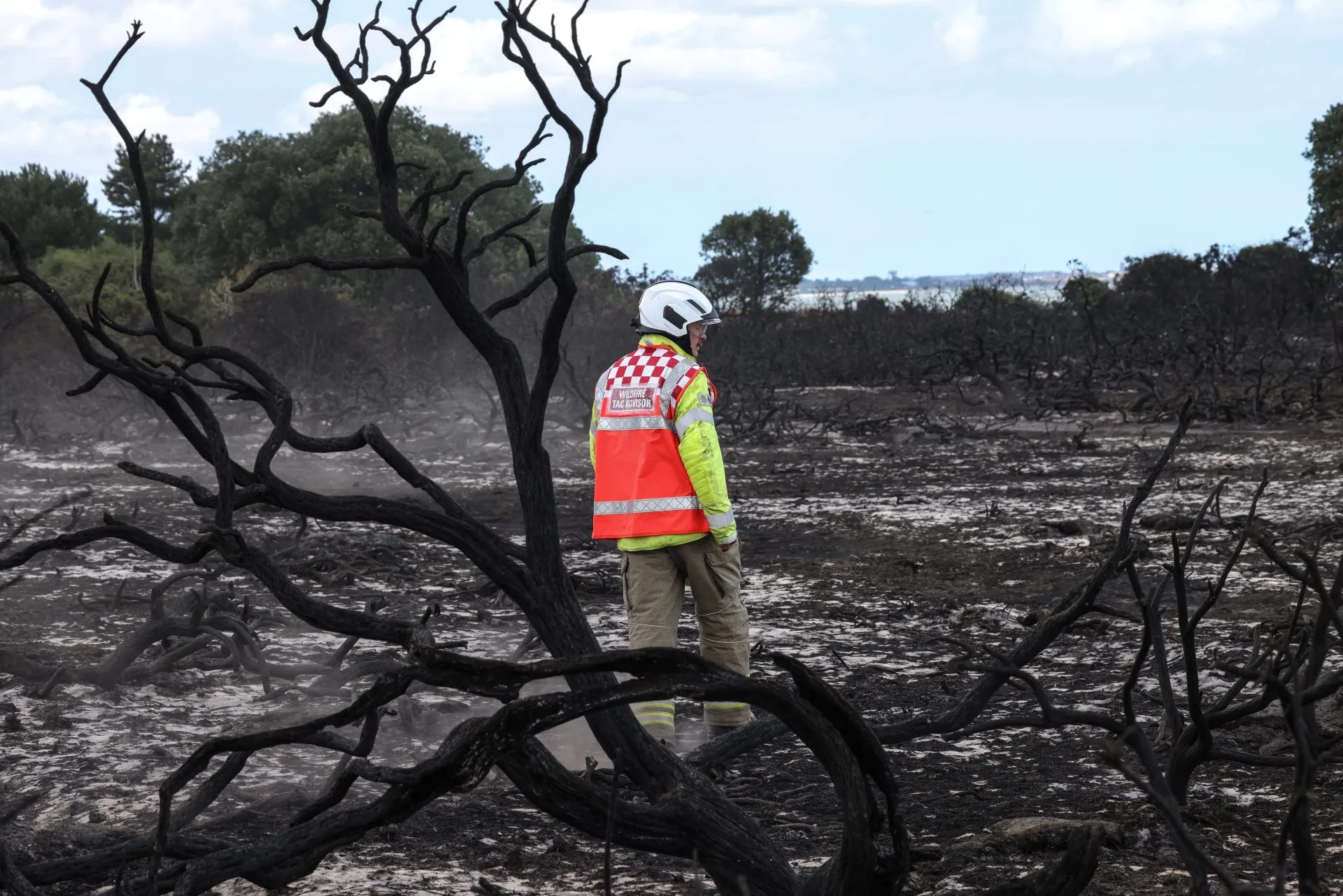
Dunwich, on England’s Suffolk coast, is one of these places. But now it is in cinders after a four-day blaze. Amid this summer’s arid, weeks-long drought and successive heatwaves, all of England is tinder-dry. In windy, flammable coastal conditions, all it took was one spark — a glint through broken glass, a careless cigarette, or abandoned barbecue.
The Dunwich fire, though now hemmed in by local fire crews, consumed 150 hectares of heath and woodland, forcing the evacuation of local villages, holiday parks, and other establishments. Conservationists are calling it a disaster from which local ecologies will take 25 years to recover. Oh, my England! But perhaps this can stand as a reminder that even this green and pleasant land, so long inhabited and so deeply over-written and sculpted by successive histories and people, still has its own elemental power; its own quiet but overwhelming force. Its own spirits, not displaced by industrialisation at all, that answer to none of us, but only themselves.
If you’ve encountered one of England’s thin places, you’ll know what I’m referring to: an eerie, liminal sense of things just out of eyeshot, of eyes watching you from the grass. This tends to be more associated with Wales, Cornwall, and Scotland: the uplands and borderlands less thoroughly rationalised, mapped, and subdued. But the rich tradition of artists, writers, composers and eccentrics who have fled (and still flee) to Suffolk’s big skies attests to the distinctive way this region’s own special landscape is still thick with fairies.
Think of the estuaries, where sea and sky, fresh and salt, blend imperceptibly into one another. The long cry of the curlew. Half-rotted wood, sunk in mud, clung with limpets and moss. These are English thin places that sing to something just as liminal in the English, as a people: a paradoxical love of home, but also of longing for the open sea. This is a people that looks out beyond the estuaries, the salt tang, and sucking mud — but also back at cottages, cosy pubs, and warm firesides. Suffolk captures that restless yearning for the horizon, long ground into the seafaring English psyche, and the same people’s island-dwelling love of home.
Much more than any twee nonsense about Paddington, or tea, or manners, the paradoxical, slightly melancholy experience of desiring both these things at the same time is at the heart of what it means to be English. And Dunwich is, in this sense, especially liminal and melancholy, because even before this summer’s fire most of it was already lost.
During the Anglo-Saxon period prior to the Norman invasion, Dunwich was the capital of the Kingdom of the East Angles. A thriving port covering an area similar in scale to, though smaller in population than, medieval London, it was listed in the Domesday Book as having three churches. Historians estimate its population at that time as around 3,000. In the 13th century, a Franciscan friary was built on the nearby headland. But then climate disaster struck.
A storm surge in the late 13th century repeatedly battered the region, flooding the port and gnawing at the coastline. The harbour silted up. The shore changed shape. And, importantly, the river that was the town’s raison d’être moved. Dunwich was suddenly no longer a sheltered harbour, sitting at the meeting-point of the river and the sea. Now the river was more than a mile away, winding through a different estuarial flat. The town lost its purpose. Further floods swept more homes into the sea. No one rebuilt them; people moved on.
Now, Dunwich is a tiny coastal village, home to around 200 people, a chip shop, and (temporarily, once a year) a lot of London cyclists. They gather every summer (the last event was a couple of weeks ago) to ride overnight from London Fields to Dunwich Beach, in the cult-like “Dunwich Dynamo” bike ride, known by the nutters who participate as the “Dun Run”.
The first time I visited Dunwich I was in the heady early stages of falling in love. We arrived there and were caught as instantly by the otherworldly atmosphere, as by the sea breeze. It was a bright day; we sat on the shingle watching the North Sea roll in, blue and brown, as passing dogs leaped in and out of the waves.
What Elon gets wrong about England
We built towers from the smooth rocks on the beach, dozed, dreamed amid the whisper and roar of wind and water. Hours slipped by. Time works differently there. The fairy denizens of Dunwich may not be those of green cliffs and woodland, of the kind you might still sense in (say) north Wales, or Cornwall. But they’re there. Dunwich attracts a stream of visitors so dedicated that despite its tiny population, its beachside and chip shop do a roaring trade. This isn’t just mad London cyclists. It’s that people come to be, for a little while, at the edge of everything.
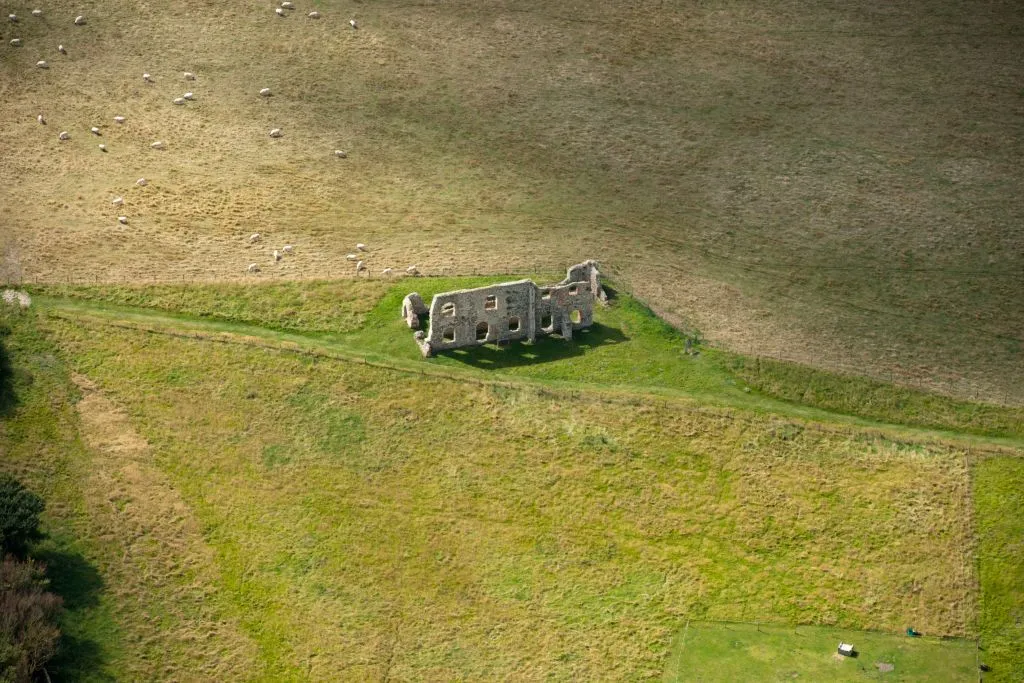
A popular local legend has it that on foggy nights, you can hear the sound of church bells ringing over the water, from the town that fell into the sea. I’ve never experienced this, but it feels profoundly true, in the sense that Dunwich is thronged with shades. The ruins of its friary can still be seen, and visited, on the headland — and here, too, many report strange happenings: weird lights bobbing about the ruins at night, said by some to be the mysterious Hobby Lanterns or jack-o’-lanterns, unexplained lights reported to lead travellers toward cliff-edges or other dangers. Others report seeing ghostly monks pacing the ruins, or hearing their chants.
Since that first visit I’ve returned as often as I can just to sit at that eastern edge of England, between sea and sky. The coastline itself feels ethereal: its very history attests to how little faith we really can place on the ground staying solid beneath us. But perhaps this summer’s blazes are less a departure from that ancient Dunwich story, than a continuation of it.
This is a part of England that’s always been thin, elemental, and only tenuously mastered by its inhabitants. War history aficionados sometimes visit Dunwich to explore the concrete bunkers that still stand along that coast, half-eroded by salt and wind, from wartime preparations for a seaborne invasion that, mercifully, never came. Its still earlier ruins were left following an invasion not borne by sea, but by the sea itself.
How to revive mythic Britain
All those centuries ago, the devouring sea, and changing coastline, shrugged off an entire habitation. This time, it was a fire that drove its human inhabitants away. I dare say they’ll be back; but perhaps we should heed the warning. We’ve grown used to an England so domesticated, industrialised, controlled and controllable as to render this kind of abrupt eviction by the landscape itself all but unimaginable. We tend simply to take for granted the belief we’ve mastered all those elemental forces, permanently, such that worrying about fire, or flood, or erosion is merely a thing of our more primitive past, or something that happens to people in other countries.
Even contemporary responses to climate change don’t really depart from this complacency. Manmade climate change is real. But wherever some kind of coordinated policy effort emerges, to respond to it, in practice this only ever seems to produce more and different technological efforts: more solar farms, different cars, a thicket of new rules.
What if the response we actually need is to think differently? Periodically some bushy-bearded Merlin type will bob to the surface of the mediasphere to warn that what we should be doing is not building more or different stuff, but attending more closely to the thin places, and what they have to tell us. No one ever listens, or if they do, somehow the product is only ever more or different stuff.
I could respond to the fire in Dunwich with a threnody for a landscape that has shaped my summers, and my imagination of England, for my whole adult life. A place I love deeply, caught as it is between land and water, singing so evocatively of both salt air, deep England, and all our accumulated centuries of ghosts. But I find that instead I read this as a wake-up call from the still deeper England, the land that was there when the Anglo-Saxons arrived, and will still be there long after we — and whoever comes after us — are gone.
However mild and generous that land is, for the most part, now and then it too can still shrug, as though scratching an itch — and, in doing so, dislodge whoever or whatever was there at that moment. Anyone who claims the right to call this land home would do well to listen. To spend time in its thin places, hear what they have to tell us, and mend our lives accordingly.
Mary Harrington is a contributing editor at UnHerd.