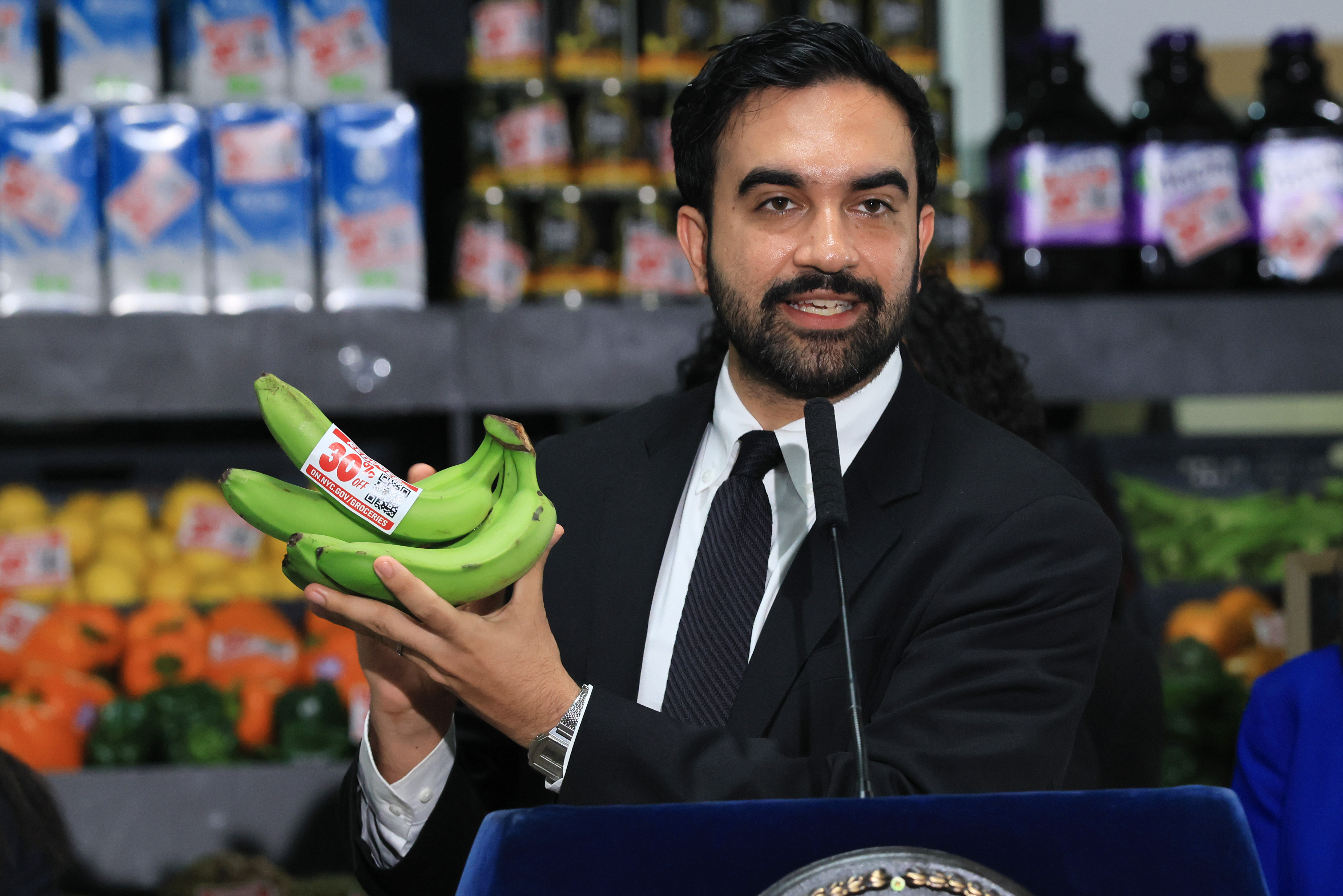
Zohran Mamdani stormed into office brandishing the banner of “affordability,” and almost singlehandedly pushed the issue to the center of today’s political debate. Of all the charismatic, 34-year-old Mayor’s initiatives aimed at lowering living costs, the one that’s garnered the most coverage is his proposal to get Gotham into the grocery business.
The city-owned food store initiative looks so radical, even for this avowed democratic socialist, because it puts a city in direct competition versus an immense, entrenched private industry. On his other big “affordability” campaigns, providing free bus service and freezing rent on one million apartments, Mamdani’s simply using his regulatory and budget powers in the Democratic mayors’ traditional vein of tightening price controls on housing and delivering more freebees
This one’s different: It’s extraordinarily rare for a municipality to challenge local businesses by starting its own enterprises that aim to do the same thing. The only major example: city-backed companies that battle the Verizons and Comcasts to supply broadband. They’re all either struggling, or already flopped. Mamdani’s predecessor Eric Adams shuttered the $2 billion fiber-optic buildout started a few years earlier under Mayor Bill de Blasio. As for supermarkets, Chicago last year killed plans for a city-owned emporium as impractical. Kansas City, apparently the only major metro ever to open a taxpayer-funded supermarket, ended the failed foray in early 2025.
Hence, Mamdani’s plan would probably reign as the biggest push any city’s ever made to launch its own business amid a galaxy of private players. The Mayor’s identified a big problem. New Yorkers indeed suffer from extremely high prices for everything from chicken to eggs to milk. The city’s riddled with “food desert” neighborhoods where residents often can’t find much other than processed items nearby, and must travel 20 minutes or more to reach outlets that offer wide choices of fresh foods at low cost.
But that drastic drought among plenty, in the metro that ranks among the world’s wealthiest, is almost totally self-inflicted. Contrary to Mamdani’s claim that “the private market alone has not delivered affordable, full-service grocery options,” here’s the real rub: A web of antiquated regulations—and one in particular that effectively bans big stores where they’re needed most—is blocking major chains from deploying billions of their own capital to open far more of the kinds of giant extravaganzas featuring baseball-field length stretches of checkout lanes that bring far lower stickers to the suburbs just beyond Gotham’s borders.
In fact, the Mamdani “solution” would make things much worse by providing rich subsidies enabling his stores to underprice private markets in the same area, potentially forcing them to close. That outcome would extend the deserts as stalwarts exit and the ones that remain hike prices. What New York needs isn’t city stores that threaten the often already struggling purveyors already here, but sweeping deregulation that encourages the entry of what consumer crave, far more supersized supermarkets that offer the widest choices and best prices..
As Mitchell Korbey, chair of the zoning group at Herrick, Feinstein, LLP, who’s represented many large chains in their efforts to establish stores in New York, told UnHerd, “Many new, large supermarkets would open if the city would lift the rules that have long outlived their usefulness.” Adds E.J. Antoni, an economist at the Heritage Foundation, “New York is really unaffordable by design, not as a natural outcome of the free market. Its zoning regulations create artificial monopolies that reduce competition and limit what would without those rules be far more and better places for people shop.”
Mamdani plans five city-owned stores offering super-cheap prices for family essentials
The mayor’s rationale: Grocery prices have jumped 30% since the onset of the pandemic, so the City will reverse that hit by allowing residents to purchase a basic shopping cart of goods 30% cheaper. The blueprint calls for five city-owned supermarkets, one in each borough that will cost $70 million in total to construct, and all operate under the single brand “NYC Groceries.” The first two are already planned, one covering 15,000 square feet in notorious food desert, the Hunts Point neighborhood of the Bronx set to open in 2027 in a former juvenile detention center, and a second in the La Marqueta district of East Harlem, another low-income area, at 9,000 square feet slated for 2029.
The stores would offer all the items you’d normally find in a supermarket, but not the cigarettes, beer and lottery tickets that are big money makers at the city’s more than 10,000 bodegas and delis. The big differentiator: The NYC Groceries sites would all offer a standardized, “core basket” of around 20 healthy products, including meat, seafood, milk, eggs and butter. The prices for that roster of produce would average 30% below prevailing retail prices for the same goods throughout New York. The City government wouldn’t run the stores. Instead, the bureau in charge, the Economic Development Corp. (EDC) has issued a 44-page request for proposals to collect bids from private operators. Those purveyors would handle all sourcing, hiring, and merchandising, and most of all, be responsible, in collaboration with the EDC, for establishing the 30% discounts. Pricing for the core basket would remain unchanged for a month, then get adjusted for the following month, a policy that the administration says will protect shoppers from the weekly fluctuations in private stores, empowering them, in the Mayor’s words, “to predict your monthly expenses.”
Companies running the stores would receive annual “affordability payments” fully compensating them for the “loss” through selling staples far below market. The operators will pay no rent or property taxes. It’s unclear if that edge would enable them to book outsized profits or even stay in business, since these would probably be smaller operators that at least will lack the big chains’ ability to secure the lowest prices buy purchasing in huge bulk from retailers.
Mamdani claims NYC Groceries will render getting fresh goods at reasonable prices “no longer an unsolvable equation,” and “a blow for economic justice.” He’s talking big savings of around $90 a month or $1,000 a year for denizens of his new markets.
New York has attracted big supermarkets in recent years, but needs far more
It’s important to note that New York has already gone a long way towards breaking from its long history of domination by relatively small, high-cost grocery stores to embracing the national and international chains that offer the widest choices and best prices. Until 1995, the city had virtually no big box supermarkets. Instead, the folks and families shopped almost exclusively at local bodegas, or at “independents” run by individual owners that operated under brand names such as Food Town, Food Emporium, Urban Market, Gristedes and D’Agostino that belong to cooperatives, and Key Food that operates its own coop, that enable them to pool their purchases from wholesalers.
Obviously, the bodegas are small at 1,000 to 4,000 square feet, but the independents are also undersized at typically 5,000 to 15,000. Because of their limited scale, the bodegas and the likes of Gristedes and Food Town offered a dearth of inexpensive generic products; they mostly had room for the pricey top brands. And that scenario caused a major turning point.
Shoppers in Harlem groused about the lack of low-priced options, and in the early 1990s, lobbied hard for a giant Fairway. Over tough resistance from local merchants, the project got approved and in 1995, a Fairway at roughly 40,000 square feet debuted on 125th Street and the Hudson River. This writer vividly recalls that many of his preppy, option-starved friends from the Upper East and West sides flocked to this unfamiliar venue in search of suburban-style vast shopping aisles and great bargains.
The Fairway (it closed in 2020) helped open the way for a number of never-before-seen, big box supermarkets from national chains. Today, Amazon’s Whole Foods boasts 16 locations in New York, including two behemoths at around 60,000 square feet, one at Columbus Circle, while Trader Joe’s offers around 18 stores, among them an Lower East Side venue at 30,000 sq. ft. The Stop & Shop array numbers two-dozen; its outpost in Rockaway Beach, Queens, occupies 30,000 square feet. International players are coming, too. Wegman’s is also present in two locations.
International brands are arriving as well. Aldi of Germany (its parent Aldi Nord also owns Trader Joe’s) operates 26 low-cost supermarkets catering to budget-conscious residents and its compatriot Lidi (owned non-affiliated Aldi Süd) has around 8 locations, also concentrated in lower-income areas.
These mega-stores usually offer better pricing and more variety than the independents. While the coop membership helps the single-owner supermarkets buy in bulk, they can’t match the purchasing cloud of a Whole Foods or Stop & Shop that respectively operate 537 and 656 stores across the U.S. What’s missing despite the influx of these big national names is that with the exception of Aldi and Lidi, they tend to cluster in such high-income neighborhoods such as Manhattan’s West Chelsea, Midtown and Upper East and West Sides, and trendier parts of Queens and Brooklyn.
That leaves sundry food deserts in such places as Central Harlem, the South Bronx, Central Brooklyn including Bed Stuy and Brownsville, and the North Shore of Staten Island. Dominating these areas are bodegas that sell mainly high quality, processed food. Fresh chicken and fish could be a half-hour away on foot. Even some plushier addresses are wanting, among them Manhattan’s Soho and Long Island City. Clearly, the best remedy to Gotham’s penury is bringing a lot more of the big chain stores the offer the widest assortments at the lowest prices, and they want to come, but in many of the places they’re most needed, the City, including apparently its Mayor, don’t want them.
Ever wonder why New York has so many drug store chains, such as Walgreens and CVS where an enormous amount of space is dedicated to food, for more than elsewhere in the country? It’s because these often super-sized venues fill the void caused by the severe shortage of big, full service supermarkets. Shoppers can get soda, chips, snacks and lots of other package good at these pharmacy-branded outlets, but not fresh food.
The reason big supermarkets, operated by national and regional operators, are so often excluded is an old zoning law that’s a competition and affordability-killer, and that affordability-king Mamdani is doing nothing about.
Here’s the little-discussed zoning rule that’s a big reason for New York’s food deserts
In the 1970s, New York City enacted a zoning regulation targeted at protecting the fast-eroding industrial base. The new rule’s purported goal: Keeping big retail stores out of spaces used for manufacturing. The law got strong support, and continues to be championed, by local merchants. “It did nothing to prevent the fall of manufacturing,” says Korbey. “It’s outdated but it remains on the books.” It seems clear that the City Council is reluctant to remove it.
Specifically, the regulation requires that any enterprise looking to build or open a retail store over 10,000 square feet in the extensive areas zoned “M” for “manufacturing” must obtain both a special permit from the City Planning Commission and a yes vote from the 51-member City Council. That’s all retail, including food stores. The M zones cover such areas as Bedford Avenue in Brooklyn, Gowanus and the Red Hook waterfront in Brooklyn, sections of East New York, and such unexpected sections as large swaths of Long Island City and most of Soho.
Many of the M areas have precisely the kind of big spaces, available land and ample parking needed for big box grocery stores. Yet it’s highly unusual for the authorities to approve them and just to get to the point where the City renders a decision is wildly expensive, a barrier that stops most candidates from even trying. As urban policy analyst Stephen Smith noted in an excellent article published in non-profit think tank Vital City, Wegman’s won approval for its store in the Brooklyn Navy Yard only after pledging to build retail and office space that remains unoccupied, and Whole Foods had to cover a parking lot with wind turbines and solar panels to win its spot in Gowanus.
To make matters worse, getting permission for a grocery superstore can also be difficult and costly, if not impossible, in the commercial and residential districts, the other two main zoning designations. Walmart avoided the M areas when tried to land in East New York, the blue-collar Brooklyn area that’s parched ground for grocery shopping. But in 2012, opposition from small business and labor groups nixed its plan, and Walmart hasn’t returned. In fact, many big stores go underground, where the 10,000-foot ban doesn’t apply. Example: the Whole Foods store on Bedford Avenue that occupies 40,000 square feet of subterranean space.
The Mamdani plan not only leaves the monopolistic rules in place, it also suffers from bad economics
It’s not just that Mamdani’s doing zilch to foster what’s really needed, letting freedom ring so New York welcomes instead of shuns private stores yearning to provide better deals than most of the ones offer now. The whole NYC Groceries structure is a primer in fighting market forces when it’s the market forces that are bound to win. The most obvious drawback is that the program doesn’t save money for New Yorkers overall. It simply transfers the 30% food savings to all residents in extra taxes.
As the Heritage Foundation’s Antoni points out, food retailers garner just about the lowest margins of any industry, about 2 cents for every dollar in sales. The five NYC Groceries mission to sell a large part of their products at 30% less would pull customers from nearby rivals, potentially forcing them to shut their doors. Supermarkets making an average 2% markup on the same items included in the “core basket” would suffer a 28% loss on these important products matching the NYC Groceries prices. Since big grocers in those areas are already scarce, the food deserts would expand, not shrink.
And what’s to prevent customers from buying loads of heavily discounted meat and fish, and reselling the stuff at a profit? Mamdani hasn’t proposed any way of monitoring who buys what to prevent such an abuse that appears such an obvious threat. Look for a thriving black market where the big buyers are middlemen who boomerang the produce to new buyers at a fat profit. We’re looking at a classic case where price controls create big rewards for cheaters who game the system.
That could actually happen. The story of super-subsidized goods is what we’ve seen in places like Cuba—they sell out fast, leaving the late comers nothing to buy. The NYC Groceries members will be severely pressed to keep shelves well stocked for items tagged almost a third lower than most other places. More likely, the milk, eggs and seafood aisles will go empty in a hurry.
New York City’s full of Cuban immigrants who’ve seen stores like this one back home. You’re supposed to get a great deal on chickens and fish, then you stand in line to get them or rush to the store and they’re sold out. Around the globe, government stores all make the same grandiose promises of bounty at a bargain, and customers will find mainly empty shelves. We’ll soon see if this daring experiment can defy all past experience, and defy what’s law rather than theory, that the market always wins.