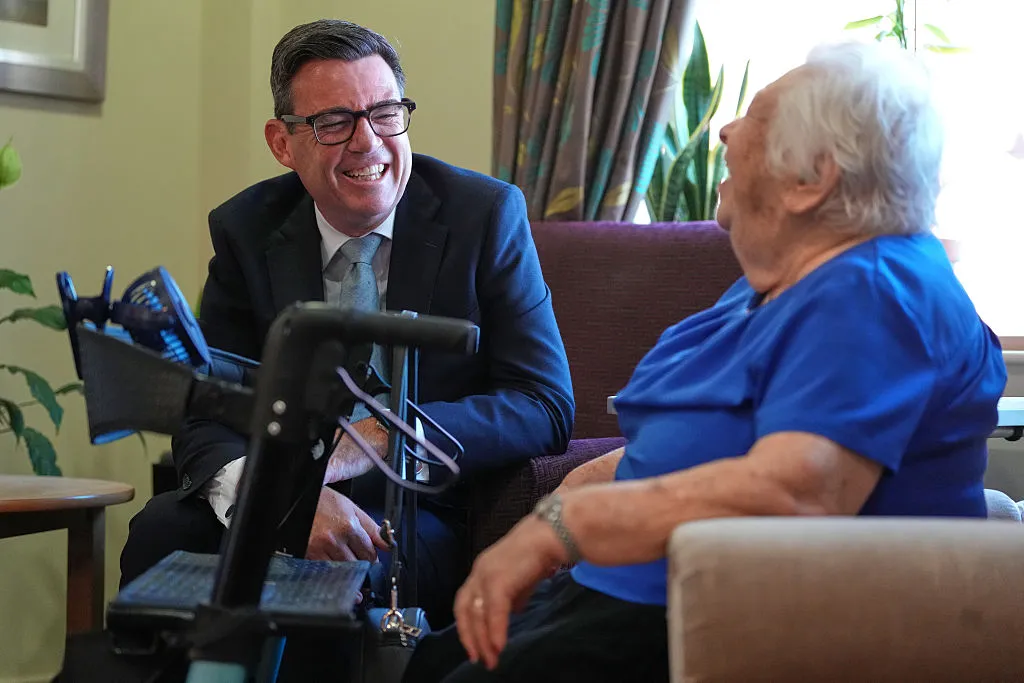
I’ve seen things you people wouldn’t believe. I’ve seen things Andy Burnham wouldn’t believe.
While lying paralysed in a hospital bed, I have watched NHS nurses telling agency staff to just stand over there and do nothing, because they were so incompetent they were making things worse by trying to help. I’ve had the terrifying prospect of trying to explain to somebody who can’t speak English — and yet is working in a spinal unit in a hospital ward — in the middle of the night, why I desperately need them to get the nurse. Because if my autonomic dysreflection isn’t arrested, I’m going to have a stroke and then die.
I’ve had the rather different experience of returning to my ward to find a care worker asleep on the radiator. If the worst three words in the English language are “rail replacement bus”, then the most terrifying for a long-term hospital inpatient are “agency staff”. NHS rules dictate that a certain number of care staff have to be on the ward floor to support nurses as a legal requirement — even if the agency staff recruited to be in line with the law make the work of the nurses harder. When I learned that these agency staff were trained over Zoom before being sent into hospitals, I wasn’t exactly surprised.
Lying behind this sorry state of affairs is the uncomfortable fact that the British electorate wants to have its cake and eat it, three ways over.
There is, for one thing, growing awareness and concern that the social care sector is in crisis. But taxes are already at a historic high, and people don’t want them to go up yet further. And although this is not polling quite as highly as it was last year, there is a clear preference for reducing the level of immigration.
This is what pointy-headed academics like me call a trilemma; it is impossible to satisfy all three preferences simultaneously. If you want more care workers there are two options. You could make starting salaries a lot higher so as to encourage far more people from the existing British population to become carers. Or you can keep starting salaries pitifully low, so that the only people who will take these jobs are immigrants so desperate for the work that they will turn up anyway.
The problem with the first option is that the only way to do this is to raise taxes in order to directly fund social care. And given that it will cost literally billions, it really will mean putting taxes up. The problem with the second is that it makes reducing immigration levels particularly difficult, given how many immigrants will be needed to cover work in social care, especially with an ageing population. And of course, if we halted immigration tomorrow, the entire NHS would collapse.
The NHS can’t fix your lifestyle
But something has to give. My own preference would be to raise taxes and pay the care workers more. This isn’t primarily to reduce immigration at the net level (which I’m personally pretty relaxed about, because I’m a wet centrist of dad-age, and I think that the net economic benefits of migration outweigh the costs of cultural conflict that arise). It is because I think that if we pay carers more, we will get better quality carers — wherever they were born.
And I speak here not just as a pointy-headed academic, but also as somebody who has (to use the jargon that I hate) “lived experience” in this area. As regular readers will know, in 2023 I suffered a rock-climbing accident that left me tetraplegic — paralysed from the collarbones down. Ever since, I have needed 24-hour, on-call care to help me with everything from going to the toilet, having a shower, preparing food, getting dressed, and making sure that if my body starts trying to kill me (which it very much can and does), somebody is close by to stop it doing that. I spent eight months in hospitals, four months in a nursing home in Enfield, and ever since I’ve lived independently, but with 24-hour assistance.
Now, before we go any further, an important point that must be emphasised. It is by no means the case that all nursing homes, and all care agencies in the UK are bad. Far from it. Indeed, I have been one of the lucky ones, who has received good care at all points.
The nursing home in Enfield was genuinely excellent — which of course is not the same thing as enjoying living there, but everything is relative in such cases. When I first moved back to Waltham Forest, I initially received care from a small-scale, locally managed agency, who did extremely well by me. I frequently spoke to the Managing Director herself, who went out of her way to make sure that her staff were not just looking after me properly, but helping me to adjust to the challenges of my new life. After about a year, we agreed that I would do better if I moved to a specialist agency that provides care only to people with tetraplegia. That is who I am with now, and it has allowed me to regain a level of independence I didn’t think would be possible.
AI will destroy universities
But it is important to emphasise that I am very much one of the lucky ones. Not least because my local authority has competent and empathetic NHS social care administrative staff, who signed off on a more expensive spinal agency taking over my care. This is not the norm. I have heard many horror stories, from others in my situation, about how their local authority basically wouldn’t agree to pay for appropriate care, usually through some mix of callousness, bean counting, and incompetence. But note: it is not an accident that the care I receive from my specialist spinal agency is the best available and the most expensive. They charge more, so they can pay their staff more, which means they can recruit better people. It’s also much easier for them to turn away candidates who are not up to scratch.
Now compare this to what most people, and their families, have to confront: the fact that vast numbers of social care workers in this country are not being employed directly by the NHS, but by unscrupulous private nursing homes and even more unscrupulous agencies.
We are not just talking about people with spinal injuries, but the huge range of conditions that require assistance for daily living: Alzheimer’s, strokes, advanced multiple sclerosis, severe learning disabilities, and a hundred other conditions that those of us who don’t suffer from them have probably never heard of. If you need social care in this country, the overwhelming likelihood is that you are going to receive it from an agency primarily concerned with one thing: extracting as much money from the NHS as it can, to feed back to its private equity masters.
The best way to do that? Pay staff as little as possible. Give them as little training as you can get away with. Don’t worry about the local authority kicking up a fuss; they can’t fully cover the cost of social care already after two decades of austerity, let alone check that you’re doing a good job. They’ll just give you the contract if you say you’ll cover it. Provided your staff don’t literally murder a client in front of the neighbours, you’re probably in the clear.
British people won’t take the work, because they have better options than the 12-hour shifts, low pay, and stressful conditions you are offering? No worries. Just exploit immigration visa exceptions for care work, and import low-skilled people from abroad. They can’t speak English? Whatever. Send them out to vulnerable people anyway. Money in the bank, Frank.
If you think I’m making this up, just ask anybody who has had to rely on one of the bigger agencies for social care provision. Like my friend from spinal rehab, who was injured at almost exactly the same time as me, with almost identical care requirements. Unlike me, however, he was not one of the lucky ones. In fact, he asked me not to use his name, because he’s scared of recrimination.
My friend has been shunted around large-scale care agencies for the best part of three years. He will tell you about the carer who ignored him as he screamed “Stop!” because his catheter was being ripped out through poor physical handling. He will tell you about the carers who don’t even try to understand what he’s saying to them (in English, which they can’t speak), and just walk away mid-sentence, before ignoring him for hours, alone in his own home. He will tell you about the one who refused to unblock his catheter, saying he was lying about experiencing autonomic dysreflexia — the life-threatening medical condition that if not resolved would have killed him. (That time he just about managed to manipulate the catheter himself. Next time, he might not be so lucky.) And yes, he complains to the agency. No, nothing ever changes. They just send fresh incompetents.
All of which makes me, I’m afraid to say, pretty pessimistic about Burnham’s promise to take the social care crisis seriously. For a start, he’s already ruled out raising taxes. And yet he claims to agree that social care workers need to be paid more. Well, Andy, how are you going to afford them?
The more fundamental problem is that the recent noise out of the new No. 10 about social care is all vibes and no concrete policy. And that’s because concrete policy is hard. In this case, really hard. As far as I see it, the only realistic chance of breaking the trilemma is not only to put up the wages of care staff (so that we get better quality people from the UK and overseas), but to remove from the equation the private equity funds that stand behind the large private agencies, more interested in their top line than you flat-lining.
This does not mean straightforward nationalisation. There are huge pitfalls with doing that, and some private agencies deliver very good services: as a general rule, the ones who are smaller scale, both in provision and staff size, and not backed by private equity. Let’s not turn the need for reform into a case for demolition.
Burnham in his first week declared that he wanted to reverse 40 years of neoliberalism. There are good reasons to think he’s using the wrong word here: neoliberalism started to die in 2008, and has been dead as a dodo since 2016. What we currently live under is something worse. Zombie-neoliberalism: the legacy of Margaret Thatcher and Tony Blair fed through the meatgrinder of austerity. Indeed, the failure of Britain’s social care system is the archetypal case. We pay higher taxes, so that private actors can get rich, while providing substandard care to the most vulnerable people in society.
Our new Prime Minister is absolutely right to want to change this. The question is: does he have the courage of his convictions? Because the rich don’t like to give up their power and their privilege, no matter how many people with severe mental and physical disabilities suffer as a result. Those who gain from private equity’s deep reach into the NHS are going to fight him on this. And they are going to fight him hard. Will he stand up to them? And if he does, can he win? I’m not optimistic.
Paul Sagar is a Reader in Political Theory at King’s College London. His most recent book is Basic Equality (2024). His Substack is called Diary of a Punter.