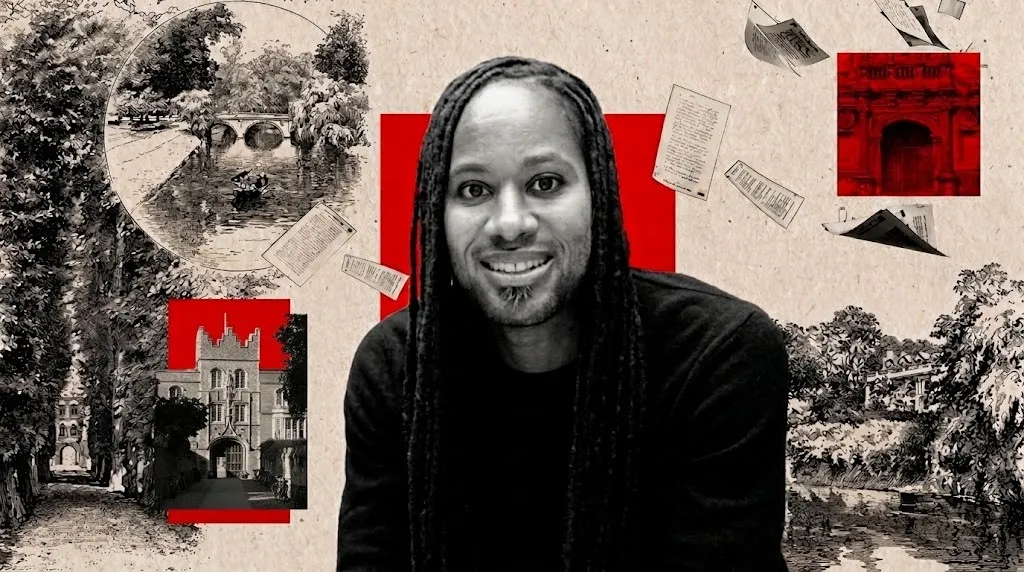
The progressive world loves a good fairy tale. Autistic and totally mute till the age of 11, Professor Jason Arday only learnt to read and write at 18. Since then, he has blazed through the academic ranks, from a lectureship in physical education in 2016, to a Cambridge Professorial Chair in Sociology in 2023 — the youngest black professor ever appointed there. He has helped the Government with its antiracism strategies; advised on the national curriculum; guest-edited the Today programme; and been the subject of a glowing profile on Good Morning America. His writing has been enthusiastically praised by James O’Brien and David Lammy. His fans now await his memoir, to be published in a month’s time.
It seems likely to be an incredible read. In various interviews, Arday has claimed to have completed his PhD with a brain tumour; to have run 30 marathons in 35 days, and 600 miles in six days; to have raised millions for charity; to have played both snooker and football at professional levels. And now there is a new chapter in this gripping life story: outright allegations of plagiarism in his academic writing and muttered suspicions of fraud. There are magical-sounding transformations here, arduous journeys, and noble heroes battling it out with dastardly villains. But who exactly are we supposed to root for, and what is the moral of the story?
For some, the obvious baddie is Arday’s recent accuser, Nathan Cofnas, who has alleged several instances of plagiarism on his Substack. Cofnas, a philosopher at the University of Ghent, is best known for his controversial research on racially based IQ differences, and for taking a Cambridge college to court, claiming it had discriminated against him on the grounds of his “anti-woke” beliefs. It is as if the most stereotypically problematic of academics had escaped from a university HR manager’s cheese dream and taken fleshly shape. Predictably, then, commentators who have based their careers on divining institutional racism have been quick to take advantage of the caricatural optics. Cambridge itself says that Arday has been cleared of “allegations of plagiarism regarding his thesis and journal publications”, and is a “victim of a vile campaign to undermine his credibility”.
But serious concerns about Arday’s work have been circulating for at least three years, voiced by scholars who have no interest in hereditarianism; and it is hard to see how Cambridge could have dismissed them so lightly. In 2023, Professor Dave Harris, an emeritus sociologist, started documenting concerns about Arday’s doctoral thesis and some other journal articles on his own website. Along with another sociologist, Professor Martyn Hammersley, Harris also tried doggedly to raise the matter with journal editors, university authorities, and Arday himself.
Harris sent me his correspondence. To his polite enquiries, Arday insisted he would consider future contact from Harris as bullying and harassment. Cambridge’s Head of Policy told Harris that, since the alleged issues preceded Arday’s time at Cambridge, it was not within the university’s remit to investigate — a bizarrely relaxed attitude to the possibility that a star academic had committed research malpractice. Last year, Times Higher staff reporter Jack Grove looked into the case in great depth, drawing in part upon evidence from Harris and Hammersley, but his editors spiked the piece after legal letters from Carter-Ruck.
It is clear, then, that more reputations are at stake here than Arday’s own. When he was first appointed as a Professorial Chair, Cambridge made huge capital out of the moment, stressing the significance not just of their new hire’s ethnicity but his “neurodiversity” too. The well-known theory of intersectionality has it that a black or brown ethnicity, plus a disability, equals the likelihood of exponential discrimination. Alongside this dogma runs a shadow logic for progressive employers, whispering that two protected characteristics in a prominent employee are even better than one; three, if you count Arday’s origins on a deprived council estate. Or as the University press release put it at the time: “parts of [Arday’s] story… epitomise the significant barriers that neurodivergent individuals, those from lower socio-economic backgrounds, and Black, Asian and Minority Ethnic people face when trying to build careers in the sector”. But not at Cambridge, they might as well have smugly added.
The rewriting of campus history
Throughout his career, Arday himself has highlighted his disabilities just as much as his race. He has said he only learnt to eat for himself aged seven, and that he spent “thousands of hours in speech therapy… six days a week” from the age of three. He has claimed that the aforementioned brain tumour was surgically removed only two weeks before his PhD viva. Last year, he co-authored a book with Dr Chantelle Jessica Lewis entitled We See Things They’ll Never See: Love, Hope, and Neurodiversity, published by the elite Princeton University Press. Its subject is how “neurotypical hegemony reproduces a culture of exclusion”. The authors wax lyrical to their presumed neurodiverse readers: “Not only do you still deserve love, you deserve for your creativity to flourish and be nurtured. You still deserve ordinariness, even if you struggle to communicate your passions.”
As this suggests, the book is an extremely weird mix of academic jargon and chatty informality. Each chapter starts with a song lyric. Chapter Seven, for instance, begins with the Blur lyric “hold on for tomorrow”, then explains: “For neurodivergent people, who are often holding on to the coattails of neurotypicals, there is a need for the neuromajority population to be more accommodating and understanding in this process… and hold on for tomorrow.” There is also a lot of breathless metacommentary, as if the authors were fascinated with their own creative process — a feature often found in student essays, but not so much in work by senior academics. In Chapter Three, for instance, you get: “it will come as no surprise to many of our sociologist peers that this third chapter was one of the last we put together”; and “[a]s we returned to Durkheim’s analysis when writing this book, a sense of sadness and frustration often entered our conversations about neurotypical hegemony”. In Chapter Seven: “As we began to round up our reflections and the rationale of the book, we spoke a lot about the concept of time and our general sense of getting through the day.”
Irrespective of the outcome of the plagiarism allegations, it seems to me there is an even more fundamental problem here. Having waded through some of Arday’s books, articles, and talks, it is my strong impression his published outputs would be judged unambiguously mediocre, bordering on comically terrible, were it not for the heroic DEI-friendly backstory. As Cofnas has pointed out, his journal articles are full of typos and solecisms, and there is even a rogue apostrophe in his PhD title. His 2019 monograph, Cool Britannia and Multi-Ethnic Britain: Uncorking the Champagne Supernova, is also strikingly garbled, as he uses autoethnography about Britpop in order to pursue “an uncomfortable discourse for melancholic Britain to digest”: that the cool Britannia of the Nineties was actually cruel, racist Britannia instead.
Here, Arday relates how he fell in love with bands like Oasis at a young age, “or at least so it seemed until the veil of innocence and naivete was stripped away through the most pernicious and insidious of discriminatory instruments… racism”. The dramatic pause is his. Other phrases tend to collapse under their own weight: “Significant periods in most individuals’ lives prove to be a point of discovery which can often lead to a sense of belonging that is hard to quantify”; “There are periods historically which capture the mood of a generation and become the soundtrack to a particular type of lived experience”. The book was nominated for a British Sociological Association prize in 2020.
Arday’s academic talks, meanwhile, are rambling and banal, in no way consonant with his elevated rank. In his 2024 British Academy lecture at the University of Bristol, for instance — about “cultural appropriation” in Paul Simon’s album Graceland — he sounds like an enthusiastic sixth-former regurgitating talking points from a rockumentary. At one point he suggests that part of Simon’s “insecurity” and “arrogance” stems from the fact Simon is physically shorter than Art Garfunkel. At another point, he digresses and starts talking about the lack of indigenous actors in Neighbours and Home and Away, observing that “you become a sociologist and start looking at it through a different lens; you start thinking ‘well Australia had an indigenous population… how come none of them are present in the utopia of Summer Bay?’”. And his interest in these two TV soap operas is not merely in passing; in a podcast interview last year, the Professor said he sleeps “probably two hours a night… then in that two hours in between, I fill it with Home and Away and Neighbours”.
There is currently some bafflement on social media about why Cambridge authorities are disclaiming the accusations about Arday with such aggressive, self-satisfied certainty. I have a possible explanation that is only secondarily connected to skin colour. Namely: at some point, the university sector decided that intellectual disability was something that should be mitigated, rather than treated as disqualifying one from scholarly life. Conditions such as dyslexia and dyspraxia, autism, ADHD, speech delay (and so on) were now to be treated as unfair obstacles to a person’s dreams of pursuing an academic career, rather than constituting evidence they were unsuited. And since over-diagnosis of mental health conditions is rife in the sector, and everyone is frightened of being called discriminatory, the predictable upshot was that — at least in some cases — straightforward midwittery came to be treated like an excusable intellectual disability as well.
Lecturers are now routinely expected to make adjustments to their ordinary critical approach as soon as someone has a diagnosis: to ignore spelling mistakes; mentally rearrange sentences without critical comment; try not to mind paragraphs that go on for days, or seem utterly arbitrary in their shape. I speak from experience. As a marker, you are supposed to look beneath the jumble of words and find the true scholar lurking shyly within. Most often, this nonsensical strategy is applied at the level of students; but once the principle was conceded, it was only a matter of time before such accommodations were extended to staff too.
On Bonnie Blue and Roger Scruton
Primed by his amazing personal history, Cambridge bosses seem to have taken this patronising approach to the quality of Arday’s outputs, just as other august bodies presumably did before them: Glasgow University, where Arday was also a Professor; the British Sociological Association, where he is a trustee; Routledge and Princeton University Press, the publishers of his books. According to the unspoken norms of these institutions, it doesn’t matter how silly Arday sounds in interviews, or how bad his writing is. It is already priced in. To point out the fact wouldn’t just be rude, it would also be positively discriminatory in a vague sort of way; whereas to ignore the issue is virtuous and noble. Many people have noticed marked inadequacies in Arday’s work over the years, I assume, but very few have said anything. And I also assume that the pressure to stay silent has increased, the higher he has climbed. What’s this? You are pointing out Professor Jason Arday of Cambridge University — a man who has been through so much to get where he is — can’t write coherent sentences, or stay on-topic in his talks? Are you some kind of Nazi?
Cambridge’s stubborn defence of its employee in the light of the plagiarism accusations looks to me like just more of the same. Managers there don’t seem to see the deliberate repetition of other people’s phrases as any kind of vice, in his particular case — it can only be inadvertent and excusable, given his known disabilities, and so perhaps doesn’t count as plagiarism at all. And it seems his race might be being treated as an additional mitigating factor, based on the assumption he routinely undergoes racist treatment which causes him psychological distress.
For instance, in correspondence between Harris and Head of the Cambridge Faculty of Education, Dr Hilary Cremin, Cremin said that when she had asked Arday about Harris’s plagiarism allegations, the former had “spoke movingly about his ongoing experiences of direct and indirect racism, and the conditions that he was living in whilst the… article was being prepared”. She also stressed that her faculty remained “immensely proud of Prof Arday’s achievements and scholarship”.
You’d be forgiven for thinking here that Cremin was trying to offer mitigating circumstances for a troubled but promising undergraduate — except that she was talking about someone holding a Professorial Chair. Once a narrative of mental disability is firmly in place, it seems that a presumed experience of racism can just be added to the list, as yet another unfair impediment to intellectual achievement. Minority ethnicity plus disability now equals the suspension of critical judgement.
Ultimately, there are likely to be many losers in this embarrassing debacle: deserving young scholars who were overlooked as Arday was appointed, now lost to the profession; fee-paying students who came to Cambridge or Glasgow to bask in the intellectual glow of world-class academics, and got some waffle about Australian soap operas instead; accomplished black or brown researchers smeared by association, now facing abuse online from hereditarian idiots who assume that Arday’s case is the norm. And ultimately, Cambridge University will be a massive loser, deservedly so. It is a necessary condition of the place’s continuing glamour and prestige that it enforces rigorous academic standards. To be shown not to care about this, in such a public way, is an act of catastrophic institutional self-harm.
But I can’t help thinking another loser is Arday himself, wandering like a modern-day Forrest Gump through various prestigious institutions, treated like a sage for every strange or incomprehensible thing he says. To be radically unsuited to an Oxbridge professorship is scarcely something to be ashamed of. Indeed, these days, in my book, it is practically a badge of honour. There are plenty of decent jobs Arday might have found earlier on, more suited to his skill set, which would not have set him up for such public humiliation later. Yet — whatever pieties university managers spouted at the time of his appointments — ultimately, the real reason for his elevation was that they saw the symbolic benefit of his protected characteristics for themselves. Irrespective of the truth about his research techniques, it is obvious Arday is already being treated by Cambridge and other places as — quite literally — a useful idiot. His fairy tale is not yet over; but I think we can already identify some clear villains.