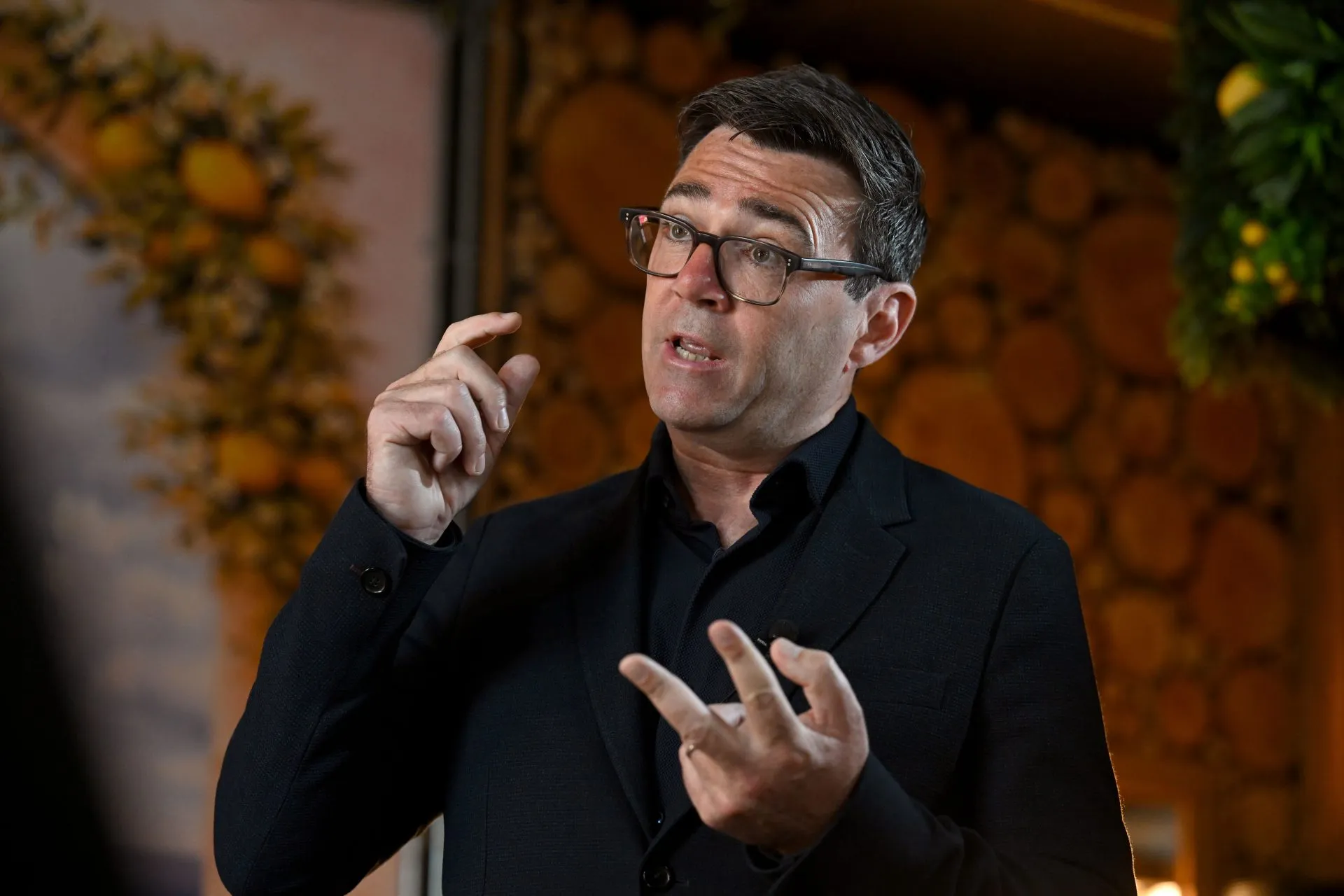
Andy Burnham is a wool. To those unlucky enough not to hail from the new home of English power — the North West — “wool”, or “woolyback”, is a gently pejorative term for someone from just outside the limits of the City of Liverpool proper. Imagine softer accents and leafier streets; historic Lancashire mill towns and pit villages in those places radiating out from true Scouseland on the banks of the Mersey. In fact, Burnham is enough of a wool to almost be a Manc: his native Culcheth is near equidistant from the region’s two rival metropoles. If he’d been full Scouse, he probably wouldn’t have been accepted as Manchester Mayor. But now he’s ensconced in No. 10, much of Liverpool will gladly accept him as “one of our own”. “Wool” was once used to divide and exclude, but now Andy has been welcomed back in the fold. One wool politico even texts me to say he’s the “Wool Mandela”.
When Burnham describes his political awakenings, he likes to hark back to his Eighties boyhood, and to where he thinks it all started to go wrong: when the country adopted something he calls “neoliberalism”. He likes to describe it as a free-market economic model through which “political power was centralised, economic power privatised, large parts of the country deindustrialised”.
But if Burnham the wool came of age in the physical space between Liverpool and Manchester, he also finds himself torn by their different civic responses to this supposedly neoliberal age. Where Liverpool “dared to fight”, railing against budget cuts and the harsh medicine of monetarism, Manchester would become a model pupil of civic governance: sensible, moderate, business-friendly, and co-operative (the divergent fates of the two cities since is instructive). And Burnham the politician wavers between the two poles, the consummate wool: unsure of whether he is more a radical Scouse shop steward, raging against the dying of the light, or an industrious, pragmatic Mancunian.
But what exactly is Burnham railing against? What does it mean to describe our system as “neoliberal”? After all, state spending and the overall tax burden is currently at a 50-year high. Britain hasn’t run a current budget surplus for two decades. Public and private developments alike are constantly blocked by Nimby councillors who act as the political gatekeepers to growth. And, what’s more, core sectors, from energy to transport and a monolithic NHS, are either in public hands or heavily regulated by cumbersome public bodies.
It’s true that the country did experience something of a neoliberal revolution in the Eighties. Deeply ideological actors — some self-identifying as “neoliberals”, others as followers of Friedman or Hayek — set about transforming the country’s modes of economic governance: capital controls were removed, industries sold off, the trade unions emasculated. The neoliberal advance was very real.
Labour's next civil war
But it was halted in 2008, when the whole edifice of City-friendly, financialised, borderless, free-trading capitalism came tumbling down. It may have taken a few years to register with the political classes, but by the time of the Brexit vote, it was clear that a realignment, a correction, was on the cards. Since then, politicians of all stripes have tentatively experimented with a more activist, strategic statism, trying to resurrect the Leviathan without ever finding or settling on a viable growth model that can deliver prosperity.
Theresa May, for one, softly embraced a more statist red Toryism, rejecting what she called “ideological templates provided by the socialist Left and the libertarian Right” to found a short-lived “post-liberal” settlement, even. But she had neither the political dexterity nor a mandate from her market-liberal colleagues to both free us from Brussels and impose “post-neoliberalism” on a post-Brexit Britain. Then came Boris, whose profligacy was infamous: the biggest capital budgets since the Fifties; nationalised steelworks; hiked corporation tax; and £300 billion to bail out insolvent businesses and pay workers to stay at home.
Perhaps the most obvious neoliberal revolt has already occurred within the Labour Party itself, beginning 11 years ago under Jeremy Corbyn. And, contrary to the generalised apoplexy from the Left, this wasn’t all washed away by a Right-wing Starmerite reaction. If you’d revealed to an inconsolable Corbynite in 2019 that within half a decade they would have a government committed to nationalised railways, a publicly owned green energy company, higher taxes, closed non-dom loopholes, VAT on private schools and more money for “our NHS” — I suspect they would have assumed that a decent, progressive, prime minister had taken charge, and that Corbynism had effected a real, lasting legacy on the party after all.
So, Andy, where exactly is this 40 years of “neoliberal consensus”, and how will your remedy be any different from what came before? We can already see the inevitable dissonance between lofty rhetoric and Cabinet picks. This, Burnham triumphantly claims, is to be the “most significant change moment” in decades. The surprise Chancellor is then revealed: John Healey, a creature of Labour’s trade unionist Old Right, a Brownite Treasury alumnus, hard-headed defence man and all-round “safe pair of hands”. The big, signalling policy opener? Around £50 a year off energy bills — unfunded, as helpfully revealed by a mischievous Darren Jones, the outgoing chief secretary to the PM, already keen to take swipes at his successors.
Yet the Healey pick also signals a seriousness around the strategy of leveraging procurement and defence spending to invest in the domestic manufacturing supply chain: drone factories for every depressed Northern town, or so the story goes. Healey, of course, resigned from Starmer’s cabinet in a row over inadequate defence-industrial plans. And it shouldn’t be forgotten that the Chancellor served in Corbyn’s Cabinet as shadow housing secretary, at a time when party policy revolved around major public investments in municipal housebuilding.
It’s possible, then, that a Burnham government will veer from an orthodox, laissez-faire, small-state approach to political economy. But it’s also clear that the roots of the PM’s anti-neoliberal tirades aren’t born of any fully developed view of recent economic history, let alone a detailed reading of the country’s very real structural predicaments. Instead, they are built on a romantic and nostalgia-tinged view of Britain, on the folk memory of postwar social democracy: the economic equivalent of Facebook’s “who remembers proper bin men?”
The Eighties were hard years for many in the woolyback mill towns and pit villages, as well as in urban Britain. As Merseyside became known as “the Bermuda Triangle of British capitalism” — any firms that went in were liable to never come out — iconic local employers from Tate & Lyle to Meccano to Dunlop moved operations to more peaceable climes. The growth model of Butskellite, post-Imperial Britain was undergoing a major restructure.
Thatcherite ministers looked at the old-fashioned, uncompetitive (and often nationalised) industries of Britain in the postwar era and saw only waste, inefficiency, and an opportunity for creative destruction. The security of a grey, plodding collectivism had to be replaced by dynamism and animal spirits. But Burnham saw it all differently, perhaps in the manner expressed in his favourite Boys from the Blackstuff episode. In the classic, Liverpool-based TV show that inspired his entry into the Labour Party, an old boy on his dying day delivers a wistful soliloquy from his wheelchair, an ode to “the ship repair men, the scalers, the dockers, the Mary Ellens who used to swab and clean the big liners”.
Where’s the economic strategy, Andy?
In the Burnhamite reading, neoliberalism killed that old world off. That’s why our seventh PM in a decade chose in his first speech as Labour leader to deliver a paean to “the mills across the Pennines”, “the shipyards on the Clyde”, “the coalfields of South Wales”. It echoed the mawkish sentimentalism of the Blackstuff. And that’s why the Blairite modernisers accuse him of pandering to a hopeless nostalgia.
But, in all likelihood, the anti-neoliberal crusading will remain in the rhetorical, romantic register — rather than being reified by a concrete, systemic break, whatever Burnham’s talk of “circuit-breakers”. The fact is that the new prime minister is hemmed in on all sides: by a recalcitrant gilt market, an unwieldy parliamentary Labour Party, an orthodox Treasury apparatus, and by his predecessors’ fiscal rules and tax pledges. Nor does he possess a national mandate to veer radically off piste from the 2024 manifesto.
In response to jitters from the financial establishment, a radically post-neoliberal Left might install a new, more pliant head of the Bank of England to support their political programme. They might also impose exchange controls to prevent capital flight, as they nationalise industries and direct capital towards domestic investment. But François Mitterrand found out how difficult such a paradigm shift could prove way back in the Eighties, as currency traders piled pressure on the Franc and forced a return to austerity. Don’t expect Burnham — who championed Gulf investment and public-private partnerships as mayor of Greater Manchester — to try the same trick.
Some on the Right clutch their pearls at the prospect of a mild pivot Leftwards, then, but Burnham is unlikely to seriously unsettle markets beyond moderate yield spikes as ministers talk of a smidgen more fiscal “flexibility”. For the Left to expect any different would be to grossly overestimate the sorry state of their own tired movement, and the very real material constraints that any government is now operating under. To that extent, Burnham will persist with incremental divergence from the neoliberal mean — just like May, Johnson, Starmer and the rest.
Of course, it’s risky to disregard the power of nostalgia, of vibes, of stories about security, collectivity and control. The vanished world of dockyards and factories offered a more comprehensible place and a more rooted common life which were shattered by the neoliberal settlement. The rhetoric can potentially act as a powerful tonic, in electoral terms. But governments can’t prosper with only an elegiac register and a robust moral tone.
Burnham will therefore eventually adopt a model of politics defined less by defiance and revolutionary change, and more by tweaks and accommodation. He’ll sell the legacy of Starmerism — the public railways, the publicly owned wind turbines — as a radical rupture. He’ll make the Left feel like they have a home in the Labour Party again, without adopting any of their harder-edged demands. That leaves the Wool Mandela roughly back where he began, somewhere between Liverpool and Manchester, radicalism and pragmatism. A wool can belong to several places at once, but as Prime Minister, he eventually has to choose.
Jonny Ball is a Contributing Editor at UnHerd. He formerly wrote under the name Despotic Inroad.