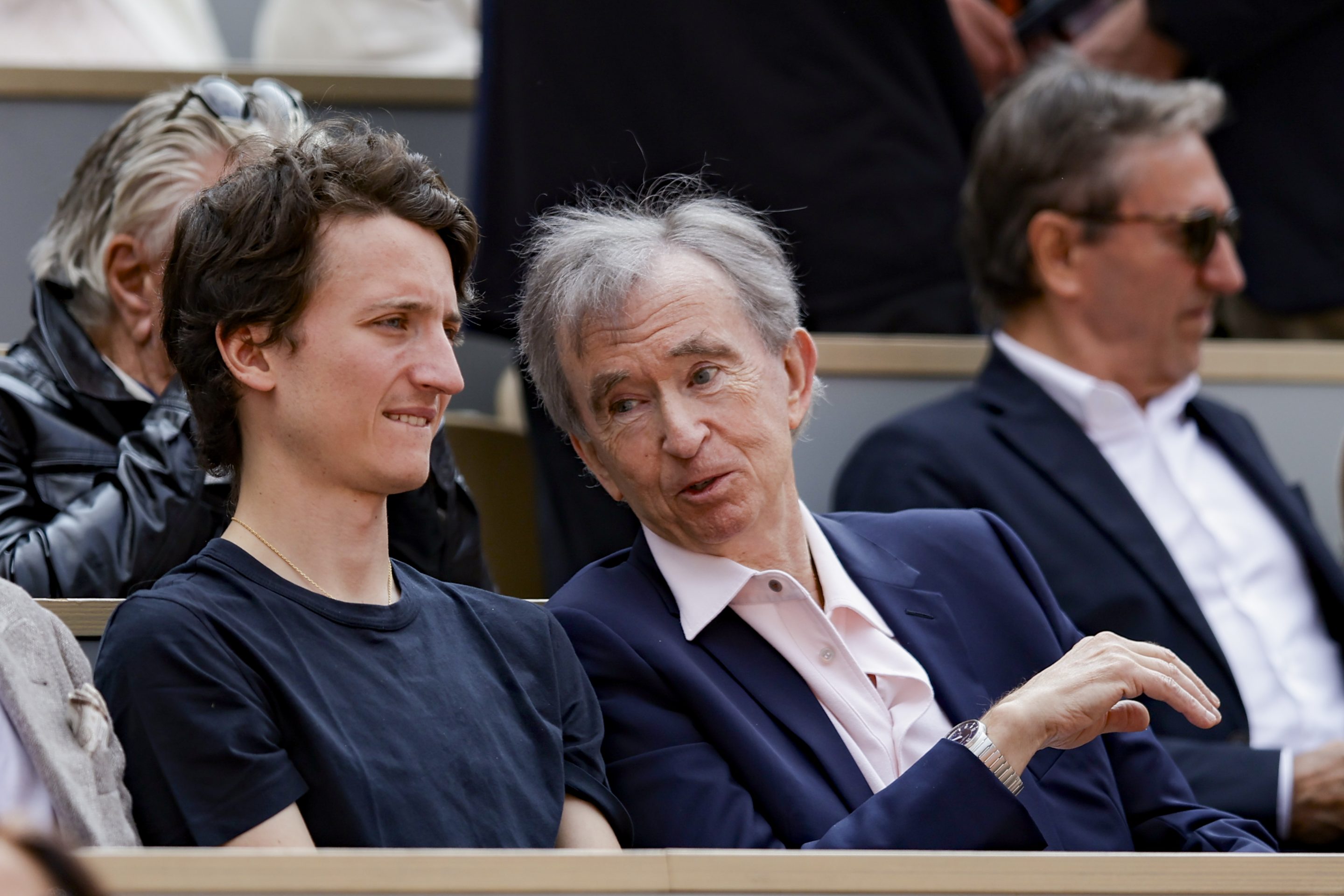
If Bernard Arnault’s family were a TV show, last weekend would have been the midseason twist: the 77-year-old LVMH chairman joined X for the first time in his life—not to sell handbags, but to insist his five children aren’t fighting over who inherits his empire.
The occasion was the conclusion of Le Monde‘s six-part investigation by French journalists Raphaëlle Bacqué and Vanessa Schneider, capped by a final installment alleging a deep rivalry to succeed Arnault among his children Delphine, and Antoine, from his first marriage, and Alexandre, Frédéric, and Jean, from his second.
“My children run Houses, build teams, make decisions, and—sacrilege—call each other on Sundays,” Arnault wrote in an extraordinary open letter that racked up 4.5 million views in 24 hours. “What, in an ordinary family, is called a Sunday is called, in ours, an intrigue.”
But LVMH’s own latest earnings filing, published two days later, tells a stranger story than the Le Monde investigation—and it has nothing to do with Sunday phone calls. In the empire often dubbed the real-life Succession, the best-performing business right now isn’t run by any of the five heirs at all.
LVMH’s highest-performing segment isn’t run by any of the Arnault siblings
HBO’s smash, zeitgeist-defining Succession ended with the Roy siblings cast out because of infighting and an outsider taking over the empire, and while that rift might not be the case with LVMH, data doesn’t lie.
LVMH’s best-performing segment this half—Watches & Jewelry, organic revenue up 9% year-over-year powered by Tiffany and Bvlgari and year-over-year profit up 9%—is run by longtime executive Jean-Christophe Babin, who started after Frédéric, 31, left that job for Loro Piana in 2025. Quarterly sales in that division beat Wall Street’s expectations by 1.88%, with Tiffany and Bvlgari both growing mid-teens.
The 51-year-old Delphine runs Christian Dior Couture and Frédéric runs Loro Piana, both inside Fashion & Leather Goods, LVMH’s largest division and the one that just posted its results: organic revenue down 1% year-over-year, profit down 7% year-over-year to €6.2 billion, and quarterly sales missing expectations by almost half a percent. JPMorgan’s Chiara Battistini, who covers LVMH and the luxury sector, called the division’s second-quarter general numbers the first hint of a turn, but flagged the deeper question still hanging over the whole division: whether leather goods, after years of runaway demand and aggressive pricing, have simply started to show “fatigue.”
Despite this, of the five siblings, Morningstar’s Jelena Sokolova, who covers LVMH, sees Delphine as closest to “the top of the pyramid.”
“She’s now CEO of Dior, and I think it’s a perfect challenge for her, because the brand has essentially slowed in the recent past, so now it has some encouraging signs of improvement,” Sokolova told UnHerd. “If she manages to accelerate the growth again, I think it would be kind of a test of her capabilities in that sense, and potential for succession.”
Wines & Spirits, the smallest of LVMH’s five core segments run by Alexandre, 34, saw organic revenue growth of 5%, a result Battistini called “a nice surprise” compared to JP Morgan’s forecast.
Category tailwinds or something more?
Sokolova cautions against reading a leadership story into the differing fortunes of the LVMH subsidiaries. Jewelry and watches are outperforming industrywide right now, she said: Richemont’s Cartier and Van Cleef & Arpels have posted even stronger numbers, and even Swatch’s lower-priced watch brands are up high-single-digits. She chalks it up to category tailwinds rather than who’s running Tiffany and Bvlgari—jewelry doubles as a store of value as gold prices climb, its customers skew toward the affluent shoppers who are spending better right now, and jewelers didn’t raise prices as aggressively as leather goods did after the pandemic.
“It’s still just a half-yearly performance,” she told UnHerd. “It’s a bit early to read into it.”
Her formal risk assessment doesn’t list succession or governance among LVMH’s threats, and Wall Street seemingly agrees, with 23 analysts rating LVMH stock as a buy, 12 rating it hold and none so far telling investors to sell, according to Bloomberg data.
Succession “is on investors’ minds,” Sokolova told UnHerd, but it isn’t “currently the major issue that is pushing the stock down,” citing the “slowdown in the fashion and leather division” also referenced by JPMorgan.
That doesn’t mean succession is irrelevant to the stock, Sokolova told UnHerd—just that it isn’t urgent yet. She points to two precedents LVMH could follow instead of installing one of Arnault’s children outright: Kering, where the founding Pinault family brought in a professional outside CEO, and Prada, where the founders “stepped away a little from the business” while keeping a non-family executive on top.
“That could be a possible option for LVMH as well, because it’s the largest group in the business, so it can attract probably the best talent, should it require to,” she said.
The real trigger to watch, in her view, is whether sibling disagreement starts blocking actual decisions—especially capital allocation and M&A, long a growth engine for LVMH.
“It becomes an issue when it starts to impact the business in a meaningful way,” she told UnHerd. “Until it does, I think it’s probably a potential risk, but not immediately a very big one.”
As of June 30, the Arnault family holds 50.2% of LVMH’s shares and 66.4% of its voting rights, a gap created by double voting rights for shares held more than three years. Four of the five children—all but Jean, the youngest—sit on LVMH’s board already.
But naming a CEO wouldn’t touch the real mechanism. In 2022, Arnault restructured Agache, the family holding company atop LVMH’s ownership chain, so a new vehicle, Agache Commandite, will pass control to his five children in equal 20% stakes once he steps back as its managing partner—shares locked in for 30 years.
Absent specific instructions, corporate filings show decisions there need at least three of the five siblings to agree. That structure outlasts whatever CEO title gets handed out—and shareholders already voted, 99% in favor last year, to let Arnault keep both jobs, chairman and chief executive, until 85.
LVMH did not respond to UnHerd’s request for comment.