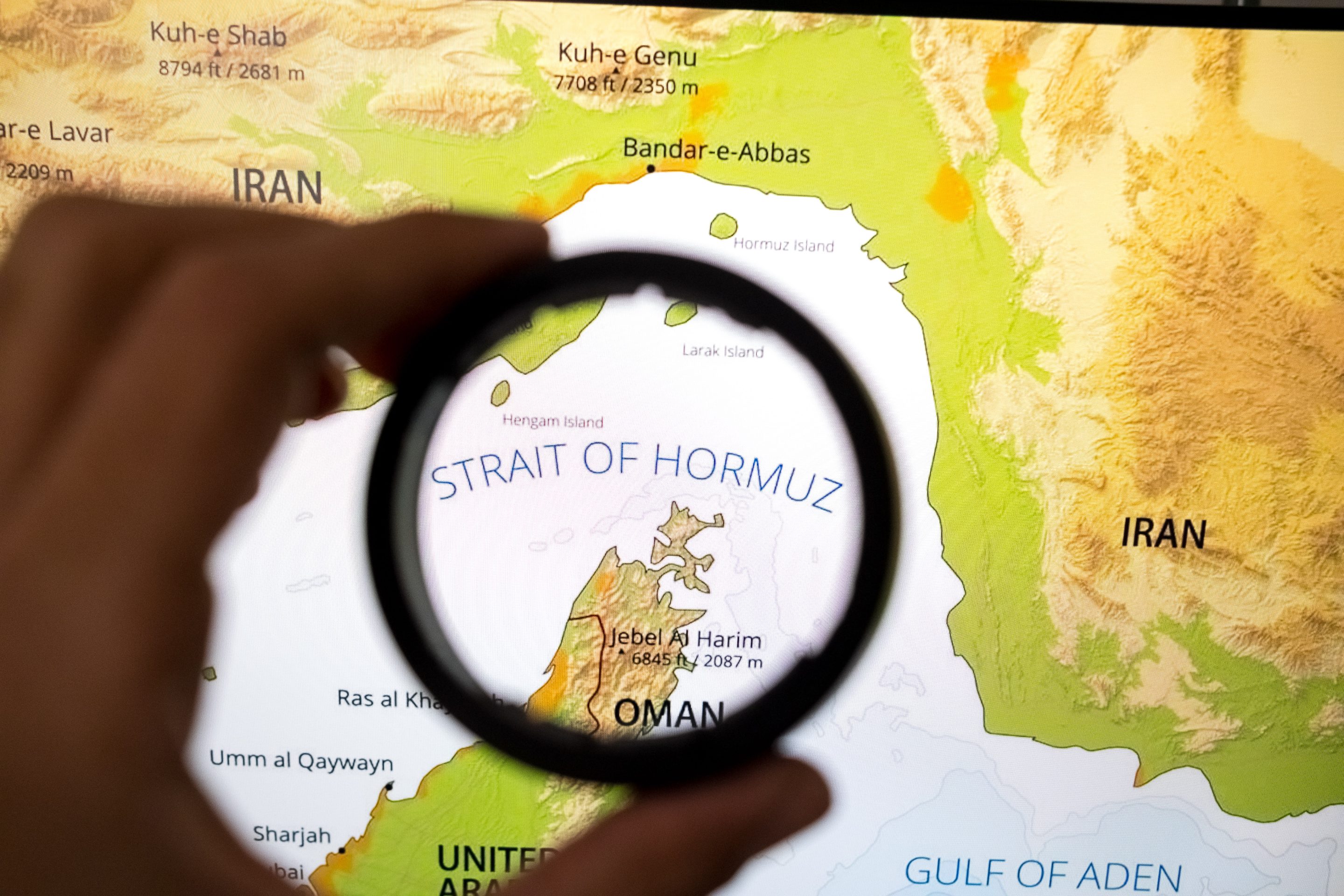
The Strait of Hormuz has become the central battleground of the U.S.-Iran conflict.
Prior to the outbreak of the war on 28 February, roughly 20% of global oil and LNG shipments moved through the narrow waterway—today, just a handful of ships are moving through, according to maritime intelligence firm Kpler.
The U.S. has launched nightly airstrikes against Iranian military targets since 11 July, while Iran has responded with missile and drone attacks on U.S. forces, Gulf countries, and shipping-related targets.
Kpler noted last week that: “While regional mediation efforts remain underway, commercial shipping patterns suggest military developments are now shaping operational decisions more than diplomatic progress.”
In its latest operational update on 16 July, the Joint Maritime Information Center (JMIC), counted 10 Iranian attacks on shipping since 25 June, and maintained a severe threat level for the Strait of Hormuz, meaning an attack is highly likely.
“Recent confirmed incidents reinforce that the threat environment remains heightened and warrants extreme vigilance,” said JMIC, which works with the navies of the Combined Maritime Forces in the Middle East Region to provide security updates, threat assessments, and safe transit advice to merchant ships and global shipping companies.
“IRGC attacks, hailing, and routing pressure continue, particularly for AIS-active vessels,” JMIC said.
On 20 July, Iran’s Islamic Revolutionary Guard Corps (IRGC) said two oil tankers had exploded and been left immobilised after attempting to cross what it described as an unsafe southern route through the Strait of Hormuz.
The IRGC allege the U.S. military had encouraged the vessels to use the passage.
Meanwhile, the IRGC said the Strait of Hormuz “will not be safe for the transit of petrochemical products, nor even a single drop of oil and gas” as long as US strikes continue. It added that it will respond with a “punitive operation”.
During a Lloyd’s List Intelligence briefing last week, Dimitris Maniatis, CEO of Athens-headquartered maritime risk management company Marisks, explained why the marked escalation in violence is leading to new challenges for shipping companies beyond higher insurance rates and contractual risk.
Crews are becoming increasingly unwilling to sail through the strait, regardless of any assurances or incentives offered to them.
“All this resonates with crews, and right now they’re just not very happy to go through, no matter what is promised to them,” said Maniatis.
“It’s not about money anymore, it’s not about any other higher calling, it’s purely about the fear that is governing the decision-making right now.”
In a research note published last week, Oxford Economics argued that accepting a toll system to enable regular trade through the strategic waterway could prove less costly than allowing prolonged disruption to continue.
Iran and Oman have both proposed introducing charges. While Tehran is proposing mandatory fees, Muscat is reportedly exploring a model based on the voluntary fees used in the Strait of Malacca or the transit charges levied by Türkiye on vessels transiting between the Black Sea and the Mediterranean. The fees help fund safe navigation and environmental protection services.
“It’s not about money anymore, it’s not about any other higher calling, it’s purely about the fear that is governing the decision-making right now”
Dimitris Maniatis, CEO of Marisks
“It’s not about money anymore, it’s not about any other higher calling, it’s purely about the fear that is governing the decision-making right now”
Both countries would be likely to frame them as service fees to conform to international law, according to the global economic advisory firm.
The Very Large Crude Carriers (VLCCs) commonly seen in the Strait and built to carry up to 2 million barrels of oil, Iran’s implied $2 million per-ship charge would translate to a $1 per barrel levy.
This equates to roughly 1.2% of Brent being priced at $86 price per barrel.
The proposed fee would markedly exceed the effective charges applied in other strategic waterways in the region, such as the Turkish Straits and the Suez Canal.
Oxford Economics calculates that, at pre-war oil shipping volumes, it could net
Iran and Oman $6.8 billion a year (1.6% of Iran and Oman’s combined 2025 GDP), compared with the $4.7bn that Egypt generated from the Suez Canal in 2025/26 (1.2% of GDP).
Furthermore, the total windfall would be likely to be higher once fees for LNG and other non-crude shipments are included.
Oxford Economics is not an outlier in proposing fees on the vessels exporting oil, gas, and related products.
Bourse & Bazaar Foundation, a London-based think tank focused on the Middle East published a report earlier this month in which it proposes targeting the largest oil tankers using the Gulf, including around 600 VLCCs that make multiple voyages each year.
With oil shipments through the Gulf worth about $600 billion annually, according to the International Energy Agency, the authors argue that a modest surcharge would have little impact on carriers while ensuring that those posing the greatest environmental risk contribute to the waterway’s upkeep.
Its proposal, which would treat the Gulf as a shared regional common market, said the fees would also be collected to help fund the services that enable the safe lifting of cargoes from Gulf ports.
The report notes that major Gulf ports already charge ships for services, suggesting it would not be a significant step to establish a regional body to collect and distribute similar transit fees.
However, any rise in transit costs would be likely to incentivise regional exporters to further diversify away from the Strait, eroding the levy’s long-term revenue potential.
Saudi Arabia has already shifted a large proportion of its crude exports to its Red Sea terminal at Yanbu to reduce reliance on the Strait of Hormuz.
Dubai-based ports and logistics giant DP World, meanwhile, is reportedly planning to develop a new port and container terminal at Fujairah on the UAE’s east coast, a move aimed at reducing Dubai’s reliance on its flagship Jebel Ali port.
Analysts from Goldman Sachs estimated in a note last week that enough Mideast pipeline capacity will likely be added to insulate over 45% of pre-war Gulf exports by the end of next year.
By the end of 2028, the figure could rise to more than 60%, with an “accelerated scenario” pushing it to 75%.
Goldman put median construction time for pipeline projects in the region at 2.5 years, “with construction typically occurring more rapidly in response to supply disruptions.”