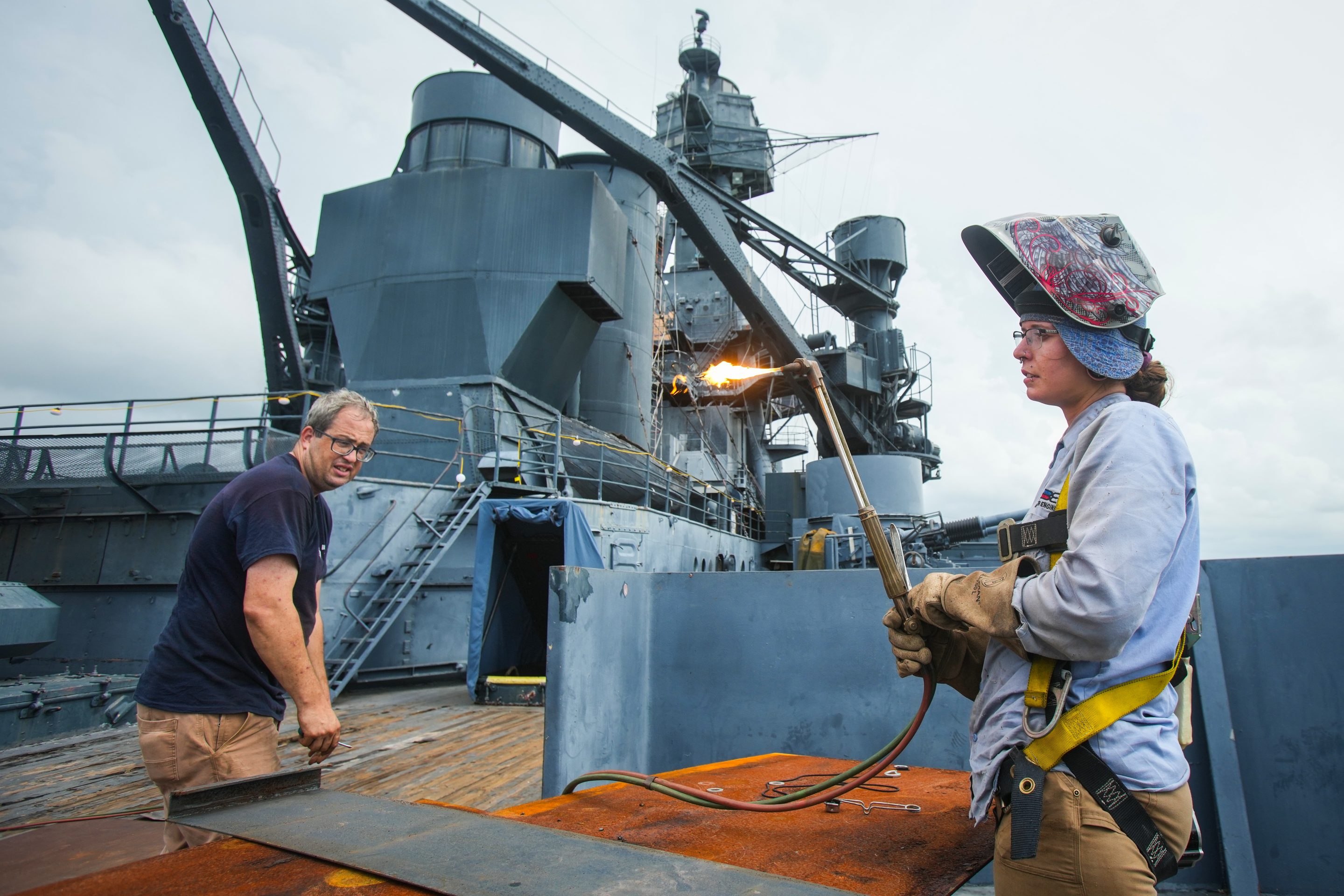
Earlier this month, JPMorgan Chase CEO Jamie Dimon pointed to shipbuilding as an example of the modern American Dream: a career where workers can earn six-figure salaries after just a few years of training while helping rebuild a critical piece of U.S. infrastructure. And while on paper, it’s an attractive proposition—in practice, it might be a much harder sell.
Shipyard jobs often require long shifts, physically demanding labor, and spending hours outdoors in extreme heat, cold, or rain. Those conditions have contributed to chronic worker shortages that defense leaders say threaten the country’s ability to expand naval production.
Attrition rates among shipyard workers have historically ranged from 20% to 22%, Eric Labs, the Congressional Budget Office’s senior analyst for naval forces and weapons, told National Defense last year. In some high-demand skilled trades, turnover can exceed 30%. By comparison, one survey found the average voluntary turnover rate in the U.S. to be 13.0% between 2024 and 2025.
“There is no way to improve the condition of the shipbuilding industrial base with attrition rates that high,” Labs said.
Former Navy Secretary John Phelan has argued pay is a main part of the equation—when workers can earn a similar amount without those dangers.
“I think this is really an issue of wages, to be honest, when I look at it across states,” Phelan said at his confirmation hearing last year, noting employees can earn a similar wage working at Amazon or Buc-ee’s gas stations. When folks are aware of what else is out there to make the same income, “it’s hard to get that person to want to do that job.”
Six-figure wages—and opportunity—are on the rise for shipyard workers
With an additional 200,000 to 250,000 maritime employees needed to meet demand over the next decade, according to U.S. Department of Labor data, the industry’s labor shortage has become impossible to ignore. A renewed push to revive U.S. shipbuilding—after decades of production shifting to Japan, South Korea, and China—has sparked a race to recruit and retain skilled workers.
The U.S. Navy committed $50 million in 2024 toward workforce development, including housing and transportation assistance, hiring and retention bonus programs, and expanded training programs. Moreover, earlier this year, unionized workers at Huntington Ingalls Industries—the largest military shipbuilder in the U.S. firm that sits at No. 352 on the Fortune 500—received a historic 18% minimum base-wage increase. Total pay is projected to rise between 35% and 47% over the next five years.
While shipbuilding jobs remain concentrated along America’s coasts, a wave of new investments is creating thousands of opportunities in those communities.
Just last week, JPMorgan announced a $24 million investment to support a new submarine manufacturing and assembly facility at the Philadelphia Navy Yard. Defense startup Saronic also announced plans to build Port Alpha, a $3.2 billion “next-generation” shipyard in Brownsville, Texas, expected to support roughly 10,000 jobs.
Saronic, last valued at $9.25 billion, said attracting that workforce will require changing what people expect from manufacturing careers. The company plans to offer production workers—including welders—the same benefits packages as software engineers, according to Natalie Wiegand, Saronic’s vice president of global expansion and integration.
Among the perks include equity compensation, a benefit more commonly associated with Silicon Valley than shipyards. At SpaceX, equity grants have helped turn factory workers, including welders, into millionaires as the company’s valuation climbed.
Beyond shipyards, maritime careers offer Gen Z six-figure opportunities hiding in plain sight
The maritime hiring boom isn’t just limited to shipbuilders.
“In the maritime industry, you’ve got an aging workforce and all of these high-demand jobs where, in many cases, kids can earn six figures shortly after high school,” said Pat O’Donnell, cofounder and CEO of Ridgeline, a San Francisco-based nonprofit building career pathways in part in the maritime industry.
As shipbuilding expands, companies are also hiring deck hands, marine engineers, logistics specialists, supply chain managers, business professionals, and vessel operators—careers spanning everything from designing ships to maintaining them to managing the global movement of cargo.
Many of those jobs don’t require a four-year degree, but when they do, one of the clearest pathways into the industry is through one of the nation’s maritime academies, including the U.S. Merchant Marine Academy on Long Island and state maritime schools in California, Maine, Massachusetts, Michigan, New York, and Texas.
The biggest challenge, O’Donnell said, remains awareness, citing the fact that some maritime positions such as welding are simply going unfilled because young people don’t know they exist.
“As a country or as a region, if we really start to invest in shipbuilding,” O’Donnell told UnHerd. “There will be so many more jobs that are going to need a pipeline that currently we’re not actually building at scale.
Do you currently work at a shipyard—or are seeking a career in the maritime industry? UnHerd wants to hear from you: email