The “right to repair” movement has traditionally focused on access to replacement parts and manuals for consumer electronics. However, the fight for more consumer autonomy has emerged in the automotive industry as well.
BMW filed a patent with the German Patent and Trade Mark Office in 2024 for a new screw design that includes the shape of its logo. It would require BMW-specific tools to remove it, effectively locking out independent auto shops that have not bought them.
“The invention is based on the objective of providing a screw which has a specific drive structure which cannot be tightened and/or unscrewed, or can only be tightened with a small number of standard screwdriving tools.” the patent states. “The shape of the engagement recesses prevents the screw from being loosened or tightened using common counter-drive structures by unauthorized persons.”
While BMW has not yet implemented its screw patent into its production, lawmakers are pushing back against automakers attempting to control who can interact with their vehicles.
Bills like the Repair Act, which was introduced in 2023 and reintroduced in 2025, would require manufacturers to provide vehicle owners and independent repair facilities with the same diagnostic repair information and tools that are already available to franchised dealerships. It would also direct the Federal Trade Commission to enforce the law against manufacturers that fail to comply.
Automotive content creator ChrisFix is one of the leading voices in championing the Repair Act online. As a car enthusiast who built a following repairing vehicles on his YouTube channel with over 11 million subscribers, he believes consumers deserve the right to choose where to get their vehicle serviced.
“On a fundamental level, I think most people would agree it’s good to have options,” he said. “If the OEMs become a monopoly, prices are going to increase substantially and that’s not good for the consumer.”
However, much of the advocacy has been focused on mechanical parts and hardware, leaving automotive advocates concerned about a car’s software.
Automakers currently can block access to repair data in their manufactured vehicles, according to repairact.com, forcing consumers to rely solely on dealership repair shops. The Repair Act would require these automakers to open access to vehicle-generated repair and maintenance data, repair tools, and even software.
“We’ve always been able to adjust, but now what we’re beginning to find is that the data that we need to be able to repair those vehicles is not being made available through conventional means,” Bill Hanvey, CEO and president of the Auto Care Association, said. “Now, with many of these EVs, all of that repair and maintenance data is transmitted systematically back to the car manufacturer, and it’s not being made available to the consumer.”
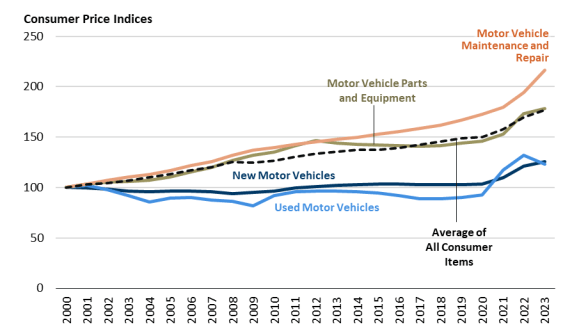
According to a report by the Congressional Research Service, many automakers attempt to limit the amount of software that is available to outside entities due to market competition. It also noted that price hikes for auto maintenance and repair have been running ahead of inflation for parts, new cars and used cars.
“The increases may reflect the power of suppliers in a concentrated market to raise prices above a competitive rate,” the report said.
EV manufacturers may also be more wary of allowing their technology to be open-source due to higher competition and cybersecurity concerns.
Louay Abdelkader, director of product management at QNX, also emphasized the importance of cybersecurity in AI-driven vehicles and highlighted the need for weighing access to vehicle systems against data protection needs.
“There has to be a fine balance between giving the consumers the ability to do certain things with a car and at the same time also ensure the integrity of not just the data, but the car itself,” he said.
But Hanvey said EV manufacturers can effectively price gouge their consumers, claiming that an aftermarket repair can be completed at up to 36% less than at a dealership shop.
According to a study commissioned by the Auto Care Association, 51% of independent repair shops reported sending up to five vehicles per month to a dealer due to vehicle data restrictions.
This can leave consumers stranded if their main source of vehicle service goes out of business.
The collapse of EV maker Fisker in 2024, however, provides an example of how to avoid that.
The California-based company filed for Chapter 11 bankruptcy in June 2024, less than a year after beginning deliveries of its flagship SUV, the Fisker Ocean.
Leading up to Fisker going belly-up, Cristian Fleming and other Fisker owners founded the Fisker Owners Association, an organization bent on continuing to give Fisker vehicles life. Soon after the Fisker bankruptcy filing, they organized and utilized independent experts to reverse-engineer Fisker software.
“In the month or so before the bankruptcy, because all of us saw it coming, people were just freaking out,” Fleming said, now CEO of the FOA. “It was born out of necessity, and the decision that we had to do something.”
The FOA also negotiated access to Fisker operating systems during the bankruptcy proceedings, coordinated parts sourcing, and developed maintenance guides to ensure the Fisker Oceans can continue operating.
Fisker owners gained access to critical components, tutorials and maintenance guides, as well as new feature updates to their vehicles through FOA. According to the organization’s website, there are 19 service shops that can service Fisker vehicles located in the United States.
Fleming predicted the future of vehicle autonomy will mirror Fisker’s situation. He hopes that vehicle ownership also includes vehicle autonomy for car owners in the future.
“I want to actually harness FOA to really explore that challenge and make it a more public thing that people are talking about,” he said. “People who own these vehicles should have some say in the vehicles they own.”