I have spent much of my working life among entrepreneurs and business leaders wrestling with a deceptively simple question: when is it time to let go? Twenty-seven years ago, I founded TIGER 21, the premier global peer network of some of the world’s most successful entrepreneurs and executives. I remain its non-executive Chairman, though 18 months ago I ceded control to a new owner, and now spend more of my time managing my own family office.
Over those years, I have watched extraordinary founders build remarkable organizations, and I have also watched some stay too long. Few decisions reveal more about a leader’s judgement than knowing when their continued presence strengthens an institution, and when it begins to weaken it. That same pattern appears far beyond business.
There is a particular kind of failure that history reserves for some of its most admired figures: the failure of people devoted to a cause who, by refusing to step away at the right moment, hand that cause to its enemies. The reasons vary—ego, misjudgment, or the counsel of those invested in proximity to power—but the outcome is consistent: supporters are left with a sense of betrayal when the failure to step aside enables the very outcome they sought to prevent.
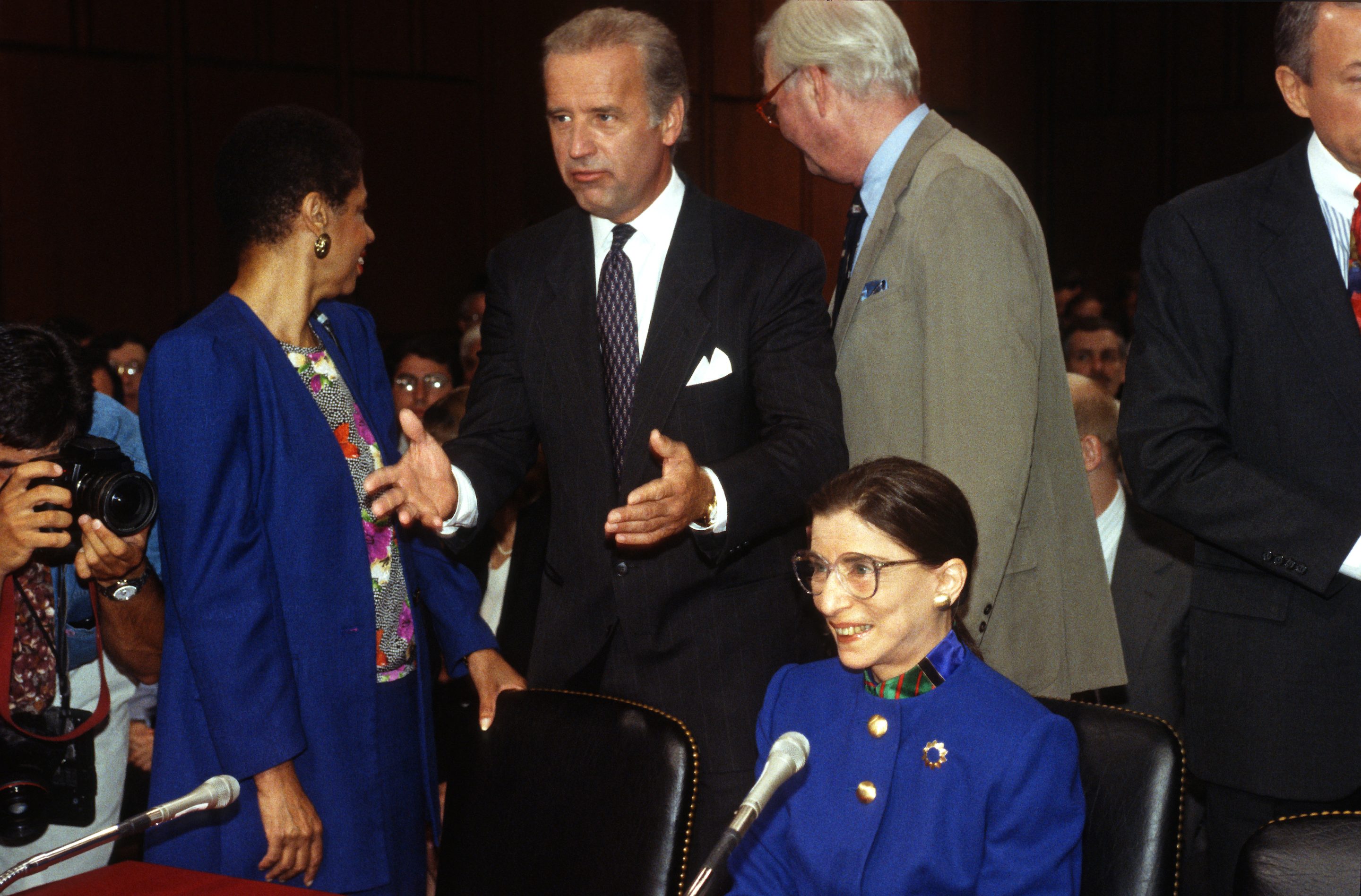
Ruth Bader Ginsburg spent her life building a jurisprudence of equality. By 2013–2014, after surviving serious illness, she had a clear opportunity to secure a successor aligned with her values. She declined, confident her health would hold and that the presidency would remain in sympathetic hands. She was wrong about who would name her successor. Trump’s Amy Coney Barrett, who replaced her, helped form the majority that overturned Roe, the decision most central to the legacy Ginsburg sought to protect. Just as important, that appointment contributed to a Court that has expanded the formal powers and protections of the presidency. The consequence is not confined to any single ruling: we now have a presidency willing to test limits and norms, reinforced by a Court that has enlarged its authority. It is the interaction of those forces, not any one decision, that gives the current moment its particular danger.
Ginsburg’s decision was a wager under uncertainty. She bet that she would live for years, remain productive, and that the political environment would cooperate. She was right about the first two and wrong about the third. Such miscalculation is human. She made a political judgment, whether or not she described it that way. She chose to stay, and the bet failed.
Having defeated Donald Trump once, Joe Biden spent four years insisting he was uniquely positioned to do so again. Having described himself as a bridge to the next generation, he might have committed early to a single term and allowed time for a genuine process to produce a successor. He did the opposite. By the time his candidacy collapsed, the time required to mount an effective alternative had largely disappeared. In withdrawing late, he effectively narrowed his party’s options at the moment they mattered most.
Ginsburg misjudged an unknowable future; Biden failed to respond to a visible present. One error was a forecast that proved wrong; the other was a refusal to act on evidence already in view. The latter is harder to defend. Nor was Biden’s failure his alone. Those closest to him had the clearest view of his condition and the greatest influence over what was shown to the country. In protecting the individual, they compromised the cause they believed he alone could serve.
What unites these cases is the indispensability delusion: the belief that the cause requires the individual, and that departure would amount to abandonment. The leader does not say, “I want to stay,” but rather “the institution cannot do without me.” This is the most dangerous form of the error, because it does not announce itself as ambition. Naked hunger for power is visible, and we know to distrust it; the indispensability delusion wears the costume of duty, telling the leader that the discipline of leaving is actually a dereliction, and that one more term, or one more year on the bench, is a sacrifice made for others rather than a comfort taken for oneself.
History is dense with this pattern, and the better cases show the same supporting cast. Woodrow Wilson, having suffered a debilitating stroke in 1919, refused to yield the presidency while his wife and physician quietly hid his condition from the country, deciding on his behalf what the nation would be permitted to know. This helped doom American entry into the League of Nations, the project Wilson had staked his name upon. A similar claim could be made about Churchill’s return to power in 1951, when a stroke two years later was likewise hidden. The principal’s delusion is the visible part. It almost always also rests on a circle of those closest to the leader who are willing to sustain it.
There is a simple test. A leader truly serving a cause larger than themselves should be able to name the conditions under which they would leave, and, crucially, should arrange their departure early enough that the cause has time to produce a worthy successor. In many positions of leadership, leaving is not a single act at the end. It is a process that must be started while there is still runway, because a successor does not appear on demand; an institution sometimes needs years to surface and test one. The leader who waits until the last moment, then announces that no acceptable replacement exists, has usually engineered that very outcome by waiting. The figure who experiences every prompt to begin the process as a threat rather than a relief has confused the cause with the self.
I write this as someone who has heard that voice. I make no comparison between myself and a justice or a president, and the stakes I faced were not remotely theirs; but the phenomenon is not confined to the highest offices. It attaches to every form of leadership, which must eventually come to an end, and that is the only standing I claim. The voice insists that no one understands the enterprise the way you do, that you and the institution are the same object, that stepping aside is a form of abandonment. Recognizing it as a liar is not the same as overcoming it. The work lies in acting against it while the choice is still yours to make.
The discipline this requires is rare, but it is not hypothetical. As the country marks its 250th year, it is worth recalling that the republic exists in its present form partly because George Washington demonstrated that discipline twice. In 1783, having won the revolutionary war, he relinquished his power to Congress rather than use it to ensure his continuation. Then, in 1796, he declined a third presidential term, establishing the principle that the office must outlast the man. He understood that precedent, not tenure, was his most important contribution. His contemporaries called him the American Cincinnatus, after the Roman who laid down absolute power the moment the crisis that summoned it had passed. That the ideal was so ancient, and the examples so few, is precisely what makes the discipline remarkable.
Modern cases confirm the test rather than complicate it. Nelson Mandela served a single term and stepped down in 1999, on a continent where liberation leaders routinely became presidents for life. The restraint was itself the message: the movement, not the man. What distinguishes these figures is that they surrendered power voluntarily, while it was still theirs to keep, at moments when continuation would have been possible or even popular. They treated departure as fulfillment rather than loss.
For those who view recent institutional developments as deeply damaging, the sense of betrayal is acute. The damage was not done only by opponents. It was enabled by those most entrusted to prevent it, acting in the belief that the cause required continuity. We expect our opponents to seek our undoing; we do not expect to be undone by the very stewards who assured us, sincerely but mistakenly, that they were holding the line.
The lesson is not that leaders should distrust their own importance. Some genuinely are, for a time, the right person for the moment; Washington was, as were Lincoln in 1864, Roosevelt in 1932, and Churchill in 1940. Indispensability is sometimes real, which is exactly what makes the test so hard: the sense of being uniquely needed is itself the distortion, weighting the case for staying when the facts do not warrant it, so that self-interest arrives disguised as the cause’s own demand. The more indispensable you actually are, the more carefully you must plan your departure, and the more suspicious you should be of any voice—your own, or those of the circle around you—assuring you that the institution cannot survive your leaving. Washington heard that voice and overruled it. That, more than any battle, is why the office outlasted him.
There is a reason this discipline is so rare, and it is not only ego. Our culture has built a shrine to perseverance. We teach grit as an unmixed virtue and treat walking away as quitting. Annie Duke, in her book Quit, argues that this is a costly confusion: knowing when to fold is not the opposite of grit but its necessary partner, a decision skill most of us exercise too late rather than too early, because identity and the fear of looking inconsistent make leaving harder than the arithmetic warrants.
Entrepreneurs feel this acutely, because the thing they are asked to relinquish is something they often built from almost nothing. To hand it on while you can still picture running it better feels like a small death, and the culture offers a vocabulary for holding on but none for leaving well. Yet the founder who steps aside at the right moment, before decline forces the question, is not quitting. The test does not care about scale. It asks only whether you can tell the difference between what the cause needs and what you need, and whether you can act on the answer while the choice is still yours to make rather than mortality’s, or the electorate’s. To leave at the right moment is not weakness. It is the rarest form of strength, and the one we have been least willing to honor.
The opinions expressed in Fortune.com commentary pieces are solely the views of their authors and do not necessarily reflect the opinions and beliefs of UnHerd.