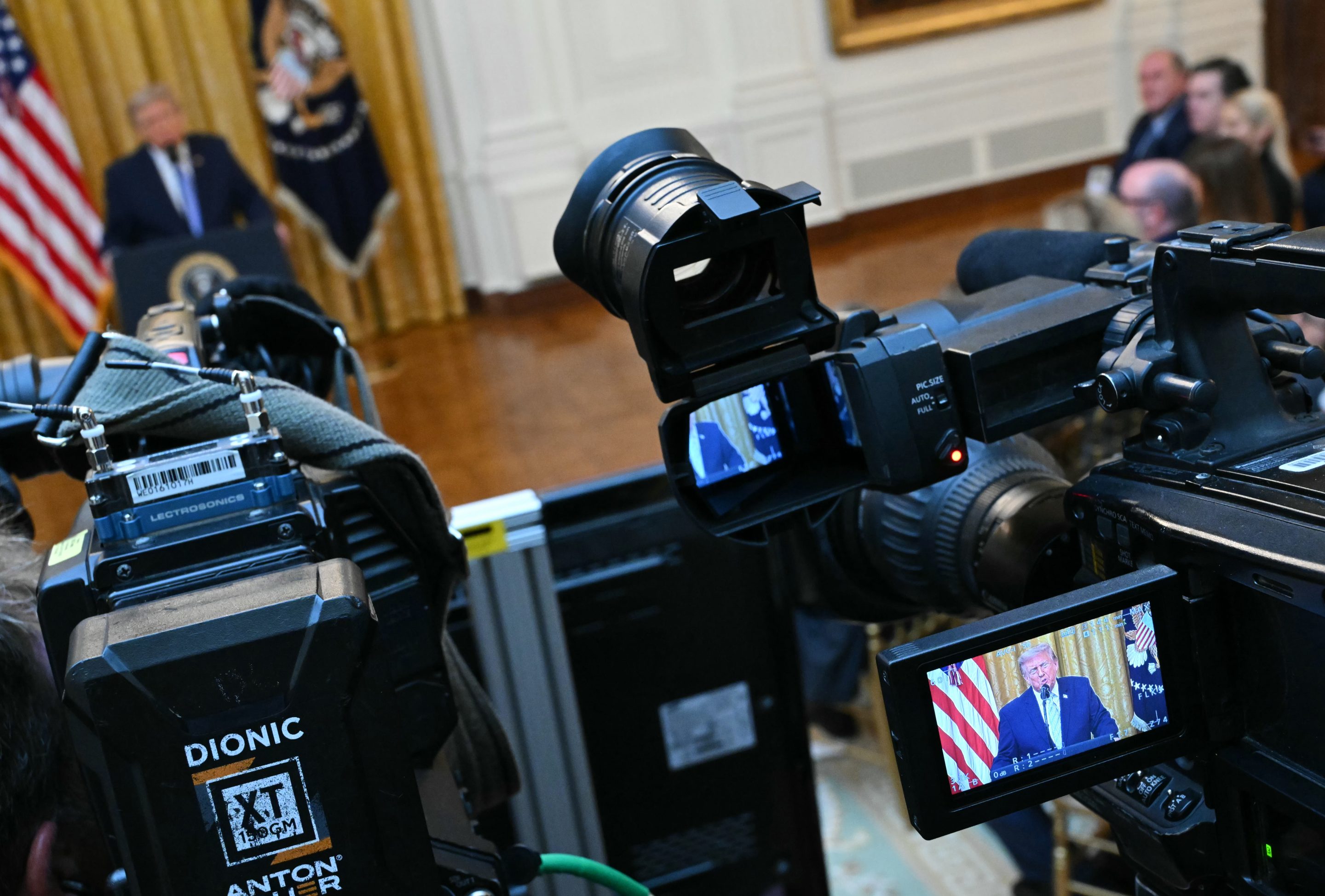
As President Donald Trump threatened sanctions for those who didn’t cover his address live Thursday night, the nation’s broadcast and cable news operations wrestled with the thorniest of questions: To air or not to air?
Networks and their news operations, broadcast and cable alike, spent the hours leading up to Trump’s address debating how to cover it — and struggling to balance delivering the news with handing over their airwaves to potential falsehoods about the 2020 elections.
In the end, a patchwork quilt of coverage was largely united by one common strategy: real-time fact-checking as much as was possible even while the president was still speaking.
The dilemma took place against a backdrop of deep tension between the media and a president working to exert control over it by whatever means he can. Even in his speech itself, Trump excoriated networks that chose not to carry it live, saying that “NBC and ABC fake news” avoided it because they “don’t like the topic.” He also threatened them with consequences, using the presidential pulpit to suggest they should be sanctioned for their editorial decisions.
“They and others in the media are part of a plot,” Trump said, offering no evidence for his assertion. There is also no evidence of fraud in the 2020 elections.
“They want to continue this fraud for whatever reason. They want to keep it going,” he said. “Fraud like this should mean a revocation of their licenses. They use our public multibillion-dollar-in-value airwaves for absolutely no money. They pay nothing. All we want is honesty in our elections and honesty in reporting.”
The tension between Trump and the news media during his second term has taken many forms, from sanctions against members of the White House press corps to regulatory actions through the Federal Communications Commission to outright lawsuits.
There were a variety of approaches to coverage
The media outlets’ decision-making — seemingly last-minute, for many, with networks divulging their plans minutes beforehand — produced a variety of coverage scenarios for the 24 minutes of Trump’s address.
CNN’s Kaitlan Collins anchored her nightly program. “We aren’t taking it live,” she said of the speech, given the president’s “well-documented history” of falsehoods. Panelists were on hand for analysis and fact-checking. “Sadly, we have no choice to be skeptical when this president talks elections,” said the network’s veteran correspondent John King.
Fox News and Fox Broadcasting aired the president’s speech live. But ABC and NBC did not, sticking with regular programming — “Press Your Luck,” in ABC’s case, and an animal show featuring alligators in NBC’s. But they were ready to cut in as they deemed newsworthy, as well as offering special reports afterwards.
Both ABC and NBC, however, provided live coverage on their streaming channels — NBC News NOW and ABC News Live — as well as ABC News Radio. In the still-young era of streaming, that is increasingly a decision that allows network news to play it both ways.
As for CBS, the network did preempt regular programming — a summer rerun of “Georgie & Mandy’s First Marriage” — to air a special report anchored by Tony Dokoupil. The report joined the live speech a few minutes in, at 9:06, and left it before the end, at 9:23.
MS NOW started airing the speech, then cut away for analysis and commentary after 17 minutes on host Jen Psaki’s show. Psaki used the split screen for a bit, with her speaking on the right and a muted Trump appearing on the left.
By the end, of the top networks, the speech was continuing live only on Fox News.
Robert Thompson, director of Syracuse University’s Bleier Center for Television and Popular Culture, said coverage of the 24- minute address made for “a weird evening, where the reporters quote and describe the speech but show little of what they’re quoting.” Thompson said full coverage was the way to go even — and perhaps especially — if the speech was believed to contain falsehoods.
“When the president of the United States makes an announcement that there is going to be a major speech with major information, however cynical we are … I think that is, by definition, important civic news significant to the citizenry,” he said. “It’s the president making the speech, and if the president does what everybody’s worried about him doing, that is a real reason to be covering it, to bear witness on exactly what gets said.”
Networks had been urged beforehand to carry it live
Earlier Thursday, at the White House briefing, press secretary Karoline Leavitt had urged TV networks to carry the speech live. And Fox News Channel’s Sean Hannity said on his show that major networks not going live was “pretty unheard of for a primetime address for a president.”
Broadcast networks, though, have previously declined primetime coverage to President Barack Obama for a 2014 speech on immigration, and President Joe Biden for his speech on democracy, “Battle for the Soul of the Nation,” in 2022.
The backdrop of Thursday’s speech was an ever-increasing tension between the media and the administration. Broadcast networks have been under close scrutiny by the Trump-appointed chair of the FCC, Brendan Carr, who has launched early reviews of licenses of some ABC-owned stations and threatened to revoke the long-held exemption from equal time rules for the popular talk show “The View.”
Trump’s animosity toward news outlets whose agenda runs counter to his own isn’t new. But in his second presidential term, he has launched an escalation, often harnessing the levers of the federal government or attempting to do so. The efforts have taken place both in actual courtrooms and in the court of public opinion.