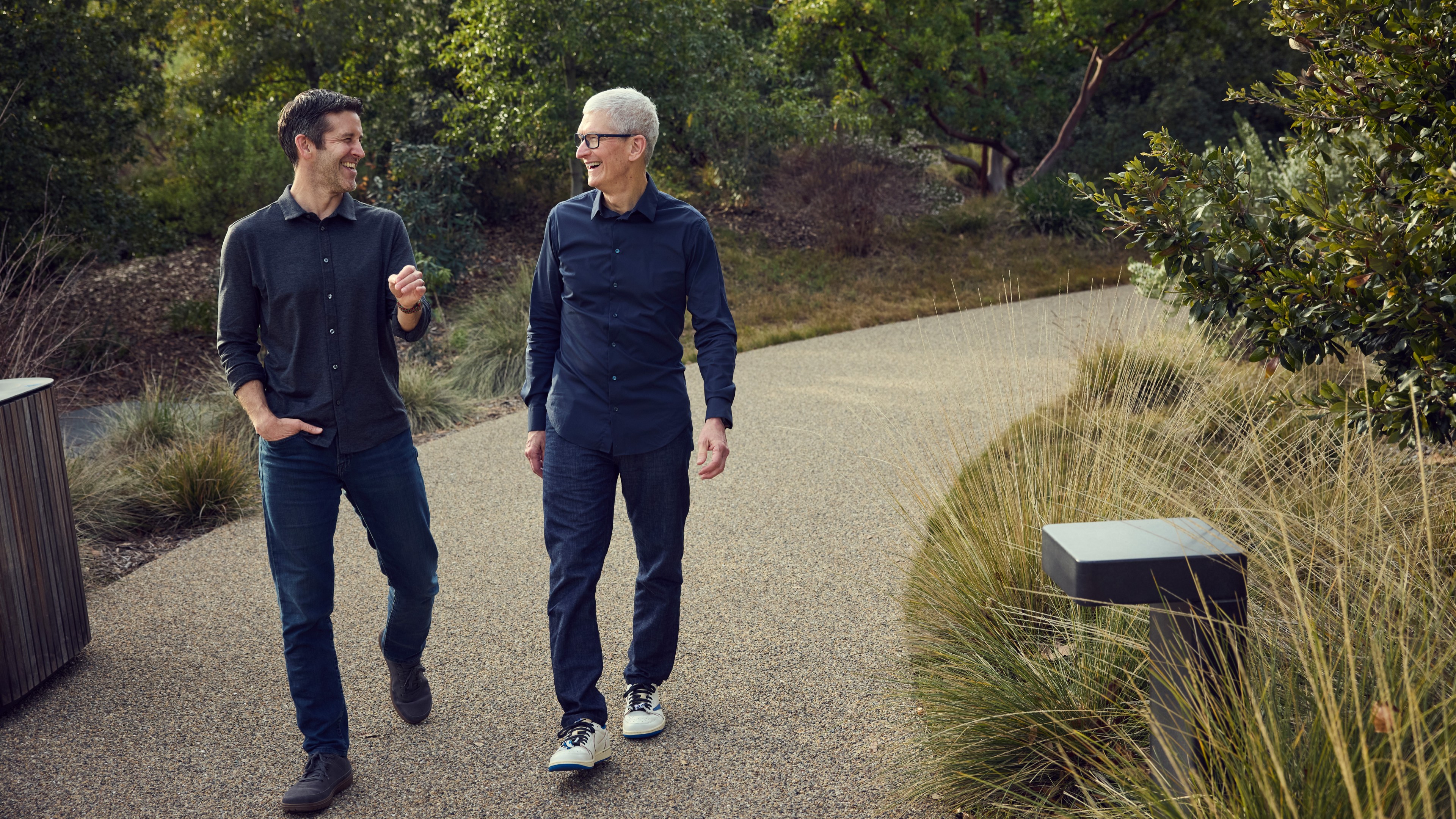
Apple’s incoming CEO doesn’t have a single post on his LinkedIn feed, and his profile is nearly blank.
John Ternus, Apple’s hardware chief and a longtime company veteran, is set to take the reins of one of the world’s most admired companies on Sept. 1, succeeding Tim Cook. The outgoing CEO will become executive chairman and retain his megaphone of over 15 million on X, while handing the operating job to someone with almost no public presence at all.
Despite leading a cornerstone of Silicon Valley, Ternus maintains a strikingly minimal digital footprint: just two roles listed on LinkedIn and no visible activity. Following Apple’s succession announcement in April, social media users were quick to seize on the irony. “In a world obsessed with personal brands, Apple just chose the guy who doesn’t have one,” one LinkedIn user wrote.
That makes Apple’s new boss an outlier at a moment when over two-thirds of Fortune 100 CEOs now have at least one social media profile, and of those post at least monthly, according to a 2025 report from communications advisory firm H/Advisors Abernathy. His quiet feed is hard to miss: as companies increasingly push their executives to cultivate personal brands online, Apple’s next chief executive appears to have opted out entirely. And while his predecessor, Tim Cook, has no LinkedIn presence of his own, he still maintains a massive audience on X, where he shares routine updates and product announcements with his over 15 million followers. Apple did not respond to Fortune’s requests for comment for this article.
I want to thank everyone for the outpouring of love and thank you for believing in me to lead the company that has always put you at the center of our work. This is not goodbye. It’s a hello to John and I can’t wait for you to get to know him like I do! 🙏 pic.twitter.com/Q43QDG3UmZ
— Tim Cook (@tim_cook) April 21, 2026
I want to thank everyone for the outpouring of love and thank you for believing in me to lead the company that has always put you at the center of our work. This is not goodbye. It’s a hello to John and I can’t wait for you to get to know him like I do! 🙏 pic.twitter.com/Q43QDG3UmZ
The job description for Fortune 500 CEOs has quietly expanded: Run the company, manage Wall Street, and act as a full‑time content creator in public. But Ternus may be less of an outlier than he seems. Even as many corporate leaders embrace LinkedIn and other social platforms for visibility and influence, a smaller cohort of executives at some of America’s largest companies continues to buck the trend.
The C-suite goes creator‑mode
Some CEOs embraced this shift early. Mark Zuckerberg, perhaps the original social‑native chief executive, regularly shares glimpses of his personal life—Brazilian jiu‑jitsu bouts, mixed martial arts training, and even surfing while holding an American flag and a beer—alongside tightly produced product announcements. Elon Musk turned X, the platform he owns, into his megaphone, posting such a firehose of commentary that people literally place bets on how many times he will post in a given week. His effusive posting style has even at times moved Tesla stock and attracted regulatory attention thanks to an infamous 2018 “funding secured” tweet that triggered an SEC investigation, a settlement that cost him his position as chairman, plus a $20 million fine.
Others, like Microsoft’s Satya Nadella, General Motors’ Mary Barra, and TIAA’s Thasunda Brown Duckett, take a more buttoned‑up approach, using LinkedIn as a controlled environment for polished product updates, employee kudos, and highlights from interviews and speaking engagements. Now, executive social media operates as an informal internal town hall.
Either way, the modern C-suite, especially the corner office, has effectively turned into a content studio, whether leaders like it or not. Today’s CEOs and executives are expected to be always-on creators: posting short-form videos, drafting mini leadership manifestos, and curating personal brands that crowd LinkedIn feeds. It’s an extra task on an increasingly long list of to-dos, and often one shepherded by a small army of social media managers, public relations professionals, and ghostwriters.
“Every major product announcement out of Meta over the past 18 months has been done by Mark Zuckerberg doing a Reel,” Ted Merz, a former journalist and now the founder of digital-first storytelling firm Principals Media, tells Fortune. “His reach is greater, and he can control the message to a greater degree.”
Even the humble earnings call is morphing into a content engine. After reporting earnings in February, Walmart CEO John Furner shared a short LinkedIn video addressed not to investors but to “associates,” thanking employees for serving customers “with speed and excellence around the world.” Airbnb cofounder and CEO Brian Chesky took a similar approach following a strong fourth quarter, telling his more than 280,000 LinkedIn followers “the bigger story isn’t the quarter, it’s the momentum.” Salesforce co‑CEO Marc Benioff has gone further still, streaming his financial updates like a podcaster, complete with a broadcast‑quality microphone, a YouTube livestream, and interviews with special guests.
LinkedIn Editor-in-Chief Daniel Roth expects future CEOs will need to be on social media, whether they like it or not. “It is the number one way that their employees understand where their companies are going,” he says. “The way it’s been described to me in lots of meetings with executives behind the scenes is, ‘my team sends emails. We have an intranet. I will write white papers for the team. No one reads any of it. No one watches any of this until I put it on LinkedIn.’”
Boards want influencers, not just operators
There’s now growing expectation from corporate boards that future CEOs show up as public faces of the business on social media, too. Boston Consulting Group suggests CEO hopefuls start cultivating a social media presence and demonstrating the ability to represent a company at least five years before expecting to take the top job. Employees also favor a CEO with an online presence. Research from Weber Shandwick found that 81% of executives believe a visible public profile for the CEO is essential to a company’s reputation, and more than half say it helps attract and retain top talent.
Ryan Barretto, CEO of social media management platform Sprout Social, says the shift shows up both in the platform data and in his own day‑to‑day. (Editor’s note: Fortune is a Sprout Social customer.) “I really do think that there’s going to be more and more pressure for not just the CEO, but executives in general, to be very, very active on social,” he says.
Sprout’s research suggests many executives are already thinking that way. In a 2023 study with The Harris Poll, 90% of business executives said social media will soon become the primary communications channel for connecting with customers, and more than half said they expect social media to become the number‑one source of data and insights to inform key business decisions over the next three years. The 2025 Sprout Social Index also found that a large majority of marketing leaders are increasing social budgets and hiring for roles in social listening and analytics—evidence that boards and C‑suites now see social as strategic infrastructure, not just a marketing tool.
Barretto argues that all of this inevitably pushes executives into influencer territory. “It’s a really big opportunity,” he says. “More and more, people are looking for human connection, and the CEO is a great example of the opportunities to be able to connect with people and actually put humanity behind the brand, someone that has real feelings, real thoughts.”
He spends roughly an hour a day on social media, posting, replying to comments, and reviewing customer feedback about the brand. That time, he argues, is no longer optional, and the payoff is tangible. “There is clear ROI from a business perspective,” Barretto explains. “It’s a huge branding opportunity, and it’s a way to drive connection.”
The reluctant influencers
Not every business leader wants to be a social media star. Former Berkshire Hathaway CEO Warren Buffett, 95, has posted just seven times on X since 2013—starting with the now‑classic “Warren is in the house”—but still has 1.7 million followers. At a 2023 shareholder meeting, the Oracle of Omaha warned about the dangers of social media: “You can sit down at a computer and screw your life up forever by telling somebody to go to hell in 30 seconds.” His successor, Greg Abel, has no public social media presence and rarely grants interviews to the business media, a stark contrast to the leader of a top-10 Fortune 500 company.
Warren is in the house.
— Warren Buffett (@WarrenBuffett) May 2, 2013
Warren is in the house.
Other chief executives are wary of the consequences but still participate, even with heightened constraints due to stricter rules on public communications for banks, brokers, and asset managers which must archive and supervise executives’ posts to satisfy regulators. BlackRock CEO Larry Fink has compared the heightened pressures and attention to living in “a terrarium,” telling the 2025 Forbes Iconoclast Summit that executives have to be a lot more guarded.”
Jamie Dimon is even more blunt. “I’m not on social media,” Dimon declared to the Female Quotient lounge on the sidelines of the World Economic Forum in January. While the JPMorgan Chase boss maintains an active LinkedIn account with over 1.7 million followers, Dimon remains deeply skeptical of the platform that nets him millions of impressions and amplifies his reach. “I think a lot of you waste a tremendous amount of time putting that shit in your brain,” Dimon told the Davos audience. “It doesn’t make you any better. It definitely does not make you smarter; it probably makes you a little bit dumber.”
The defiance is striking for a leader who has built a powerful online footprint. Dimon’s LinkedIn account, for example, regularly shares interview excerpts, podcast clips, and takeaways from his closely watched annual letter to JPMorgan Chase shareholders, reaching a global audience of investors, employees, and policymakers in their feed, and he’s even nabbed the coveted, invite-only LinkedIn Top Voice badge. His posts routinely attract thousands of reactions and comments, illustrating the paradox facing today’s top executives: Even the skeptics are being pulled into the social spotlight.
That’s no accident. Timothy Pollock, a professor of entrepreneurship at the University of Tennessee, Knoxville, argues that executives now occupy a cultural role once reserved for movie stars and athletes. “Why does what time they wake up or when they do their workout matter to them doing their job?” he asks. “But that’s what people love, because we live vicariously through our heroes. Business executives increasingly, for better or worse, play that role in society.”
For now, only a small class of leaders can truly opt out: founders with near‑mythic status like the “Oracle of Omaha” himself, or executives at the helm of brands, like Apple, so powerful that the company itself functions as the influencer. Everyone else is assessed with a different grading curve.
Celebrity CEOs in the feed
What’s changed over the past few years is that the format of executive communications is tilting toward social‑native content. Earnings videos packaged for LinkedIn, behind‑the‑scenes clips from offsites, and quick “walk‑and‑talk” explainers of strategy are becoming standard parts of an executive’s routine.
Few executives embody this “always‑on” expectation as naturally as Blackstone president and chief executive officer Jonathan Gray. His jogging dispatches have become a fixture on LinkedIn with nearly 50 running videos filmed in the past year. Between flights and investor meetings, the executive carves out time to explain economic swings, market volatility, and tech trends, all while touting Blackstone’s global reach. Since his appointment to COO in 2018, the firm’s assets under management have roughly doubled, while its client base has expanded across new geographies.
“What I found was it was an incredible way to connect with other people and also to have some content as well,” he tells Fortune. It’s a conversation starter in meetings, with clients telling him they “saw you were here” or “loved your video.” The videos have even earned him a nickname—the Forrest Gump of LinkedIn—and when he travels for conferences or business trips, “most of the time, the first thing people bring up to me” are the jogging clips, not the deals.
“At the end of the day in our business, when you’re investing capital on behalf of others, you’re a steward of capital; you’re really in the trust business,” Gray says. “Being able to communicate with your clients directly, your shareholders, and show them who you are and what matters to you in a direct way, that’s very helpful, and that’s what this has become.”
Dr. Ann Mooney Murphy, a Stevens Institute of Technology professor of strategic management, says that one-sided “parasocial” relationships built on social media can increase buying intentions and loyalty among customers, employees, and other stakeholders. “People get drawn to people, not firms,” Murphy tells Fortune. “You don’t form parasocial interactions with a company.” Done carefully, she argues, a CEO’s routine presence on social media can be a mechanism to connect with customers or investors they normally wouldn’t reach.
But the same intimacy that builds loyalty can also backfire. In early February, McDonald’s CEO Chris Kempczinski posted a seemingly routine video promoting the chain’s new Big Arch burger, which quickly turned into a cautionary tale when his taste test drew mockery from users who accused him of barely taking a bite.
“You want it to be authentic, because that’s what’s going to draw the attention,” Murphy says. “But that said, they can really make mistakes, and that can be a problem too.”
AI twins and the next frontier
As Fortune 500 executives fire up their LinkedIn apps and post snapshots from their latest conference appearance, they are no longer just competing with each other for eyeballs. They are now battling a flood of AI-generated slop.
“If you’re not on social media, you’re letting your narrative be owned by other people,” Marcia Newbert, Edelman executive vice president and lead of U.S. Corporate Digital, says. “As search changes and LLMs increasingly shape reputation, it’s just a missed opportunity.”
She points to new AI tools and chatbots trained on a creator’s voice that can reply to comments directly on social media. “I think the most enterprising CEOs are going to start to experiment in this lane.” The key to surviving the endless scroll of slop? Authentic, human-generated content.
For now, most CEOs are still experimenting with how to show up authentically on camera and in comments, and learning when to respond, when to admit mistakes, and when to log off. The ones who figure it out first, like Gray, are quietly rewriting the job description for everyone behind them.
The next Warren Buffett or Jamie Dimon may not think of themselves as influencers. But in an era when the road to the corner office runs straight through the feed, it will be hard to get there without acting like one.