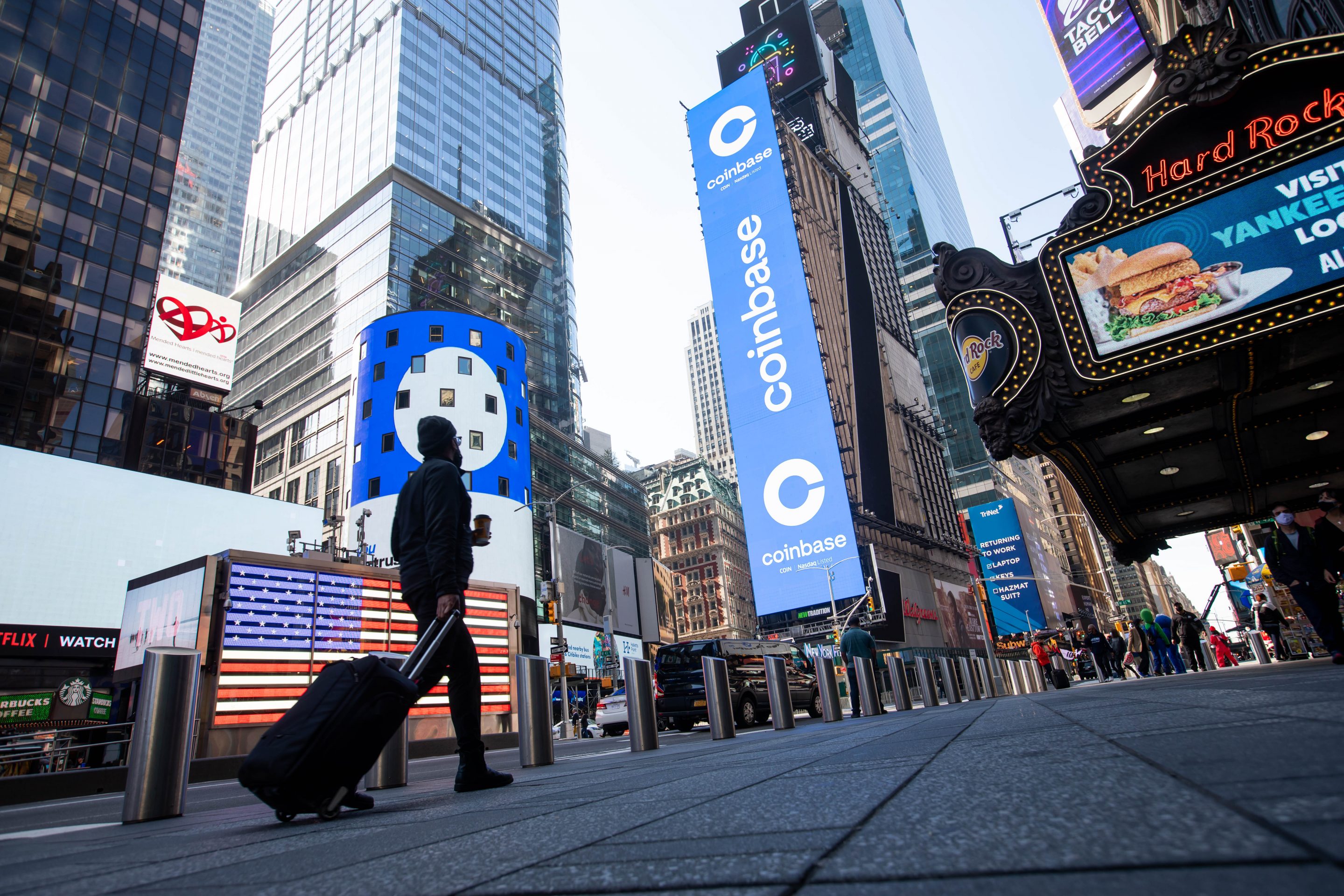
Coinbase Global Inc.’s trading debut ushered in a new era for cryptocurrencies on Wall Street, bringing the oft-mocked asset class closer to mainstream acceptance. But that’s just the sort of attention that generates outrage among a small, disgruntled cohort of the Bitcoin community.
For the most ardent Bitcoiners, the so-called maximalists who regard other cryptocurrencies as schemes to part neophytes from their money, talk of Coinbase raises hackles. To them, the idea of a centralized exchange dominating trading in what they see as a decentralized alternative to the current financial system is abhorrent.
The less extremist reasons are varied, with sentiments ranging from “there are better places to trade” to “do you know what they did,” but the tone is unmistakable.
Perhaps the most salient complaint is about the exchange’s fees, which are among the highest in the industry, according to data from CoinTracker. On its Coinbase Pro platform, maker and taker fees for trades less than $10,000 stand at 0.5%, which can be more than double what a similar trade would cost on a competing exchange such as Kraken. Flat fees on its flagship product can be even higher with levies for U.S. customers purchasing via their bank accounts clocking in at 1.49% of the transaction value.
With more than 90% of Coinbase’s revenue coming from retail trades, which made up just 36% of volume during the quarter ending Dec. 31, critics caution that the exchange’s high fees and explosive revenue growth will inevitably come under pressure as its users become more accustomed with competitor offerings.
Of course, as became clear during the GameStop Corp. mania on the nominally free Robinhood Markets platform, users often get what they pay for. Coinbase’s listed transaction costs may well be higher for good reason, accounting for better overall trade execution and higher security standards for those that keep their Bitcoin private keys on the platform.
Coinbase declined to comment through a spokesman.
$COIN IPO:
— Q-Cap (@qcapital2020) April 14, 2021
261M. shares
250$ reference price
$65.2Bn reference price
My guess 1st trade between 400-500$ or $104Bn-$130Bn
Also, how their Retail clients getting ripped off in two charts:
Retail make 36% of trade volume but 91% of revenues 🤦♂️
Hard Pass. pic.twitter.com/7A9wJzbMOx
$COIN IPO:
261M. shares
250$ reference price
$65.2Bn reference price
My guess 1st trade between 400-500$ or $104Bn-$130Bn
Also, how their Retail clients getting ripped off in two charts:
Retail make 36% of trade volume but 91% of revenues 🤦♂️
Hard Pass. pic.twitter.com/7A9wJzbMOx
Then there’s the long simmering feud about what was perceived as Coinbase’s lending its imprimatur to Bitcoin knock-offs.
The exchange has offered its users the ability to trade in spin-off protocols like Bitcoin Cash which jump-started the forking craze in which dozens of software-development teams sought to create money out of thin air by tweaking the original computer code and releasing coins with “Bitcoin” in their names.
Someone I respect messaged me confused about why I'm throwing shade at Coinbase instead of being happy for them and what they've done for Bitcoin. Full transparency, here's my response. pic.twitter.com/sRxHcIe81z
— Stephen Cole (@sthenc) April 14, 2021
Someone I respect messaged me confused about why I'm throwing shade at Coinbase instead of being happy for them and what they've done for Bitcoin. Full transparency, here's my response. pic.twitter.com/sRxHcIe81z
There’s also a sense of betrayal.
For a company inspired by founder Brian Armstrong’s reading of the Bitcoin white paper, its holdings of the cryptocurrency are regarded as paltry in comparison to the likes of MicroStrategy Inc. which has made it a crucial part of its treasury strategy.
It's almost as if Coinbase doesn't even believe in the industry in which they are one of the biggest players. Sad.
— Vijay Boyapati 🦢 (@real_vijay) April 6, 2021
It's almost as if Coinbase doesn't even believe in the industry in which they are one of the biggest players. Sad.
Coinbase held approximately 4,486 Bitcoins, according to its S-1, or about 5% of what Michael Saylor’s MicroStrategy has accumulated.