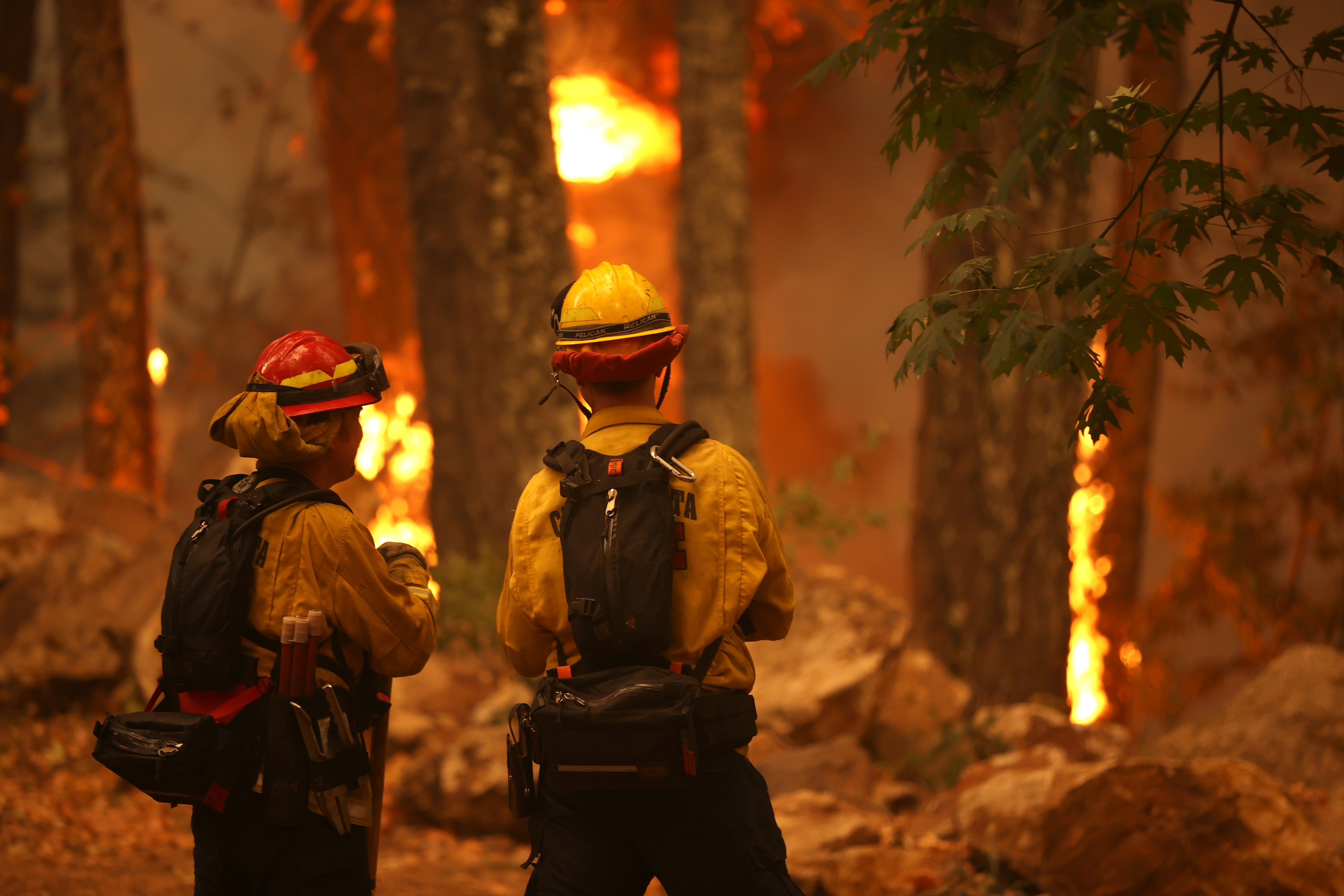
It has been an especially dry spring in California, and that’s causing scientists to sound the alarm about how the state will weather its upcoming wildfire season.
San José State University’s Fire Weather Research Laboratory said the level of moisture in plant life, which is normally at its peak in April, is far below both its annual average and previous record lows.
“Fire season 2021 is looking grim,” the state’s only wildfire research center said on Twitter.
At the center of the concern is a statistic called the fuel-moisture content (FMC), which measures the ratio of moisture to flammable material in plants, trees, and shrubs. The lower the FMC, the more prone they are to burning.
And the 2021 samples from the Santa Cruz Mountains are 40% below average.
Fire season 2021 is looking grim. Our region's FMCs are tracking lower than the minimum– a new record low. This is caused by the lack/delay of new growth. Average is 137%, low is 115%, 2021= 97% #wildfire #CAwx @wildfirecenter pic.twitter.com/u7ekJ2phjv
— SJSU FireWeatherLab (@FireWeatherLab) April 5, 2021
Fire season 2021 is looking grim. Our region's FMCs are tracking lower than the minimum– a new record low. This is caused by the lack/delay of new growth. Average is 137%, low is 115%, 2021= 97% #wildfire #CAwx @wildfirecenter pic.twitter.com/u7ekJ2phjv
Researchers said they have “never seen April fuels look so… dry” and called the phenomenon “very scary.”
The lack of rain this season has severely impacted our chaparral live fuel moistures. Wow, never seen April fuels look so… dry. No new growth anywhere in this Chamise. April is climatologically the highest live FMC of the season. Very Scary! #CAwx #firedanger pic.twitter.com/clJ92b3DiX
— SJSU FireWeatherLab (@FireWeatherLab) April 3, 2021
The lack of rain this season has severely impacted our chaparral live fuel moistures. Wow, never seen April fuels look so… dry. No new growth anywhere in this Chamise. April is climatologically the highest live FMC of the season. Very Scary! #CAwx #firedanger pic.twitter.com/clJ92b3DiX
The dry spring follows a dry winter in California. And the 2020 wildfire season was a record-breaking one, with nearly 4.4 million acres burning—over 4% of the state’s area. 2020 saw 9,639 fires across the state, resulting in poor air quality and rolling power cuts for residents.
COVID made the situation even worse, creating a shortage of wildfire fighters.
It will be several months before we learn if San José State’s dire predictions are accurate. Peak wildfire season usually occurs between July and November, a time when hot, dry winds are most frequent. Rains most often return in October or November.