Our mission to make business better is fueled by readers like you. To enjoy unlimited access to our journalism, subscribe today.
Tonight’s the night: Saturn and Jupiter will appear closer in the night sky than they have in centuries, in an astronomical event called a conjunction.
The gas giants, the solar system’s two largest planets, will appear only 0.1 degree apart overhead on Monday. They’ll move slightly farther from each other during the rest of this week, but remain unusually close.
In the northern hemisphere, the duo can be seen shining brightly in the southwestern sky soon after sunset. In the southern hemisphere, they’ll glow in the western sky.
In reality, the planets are separated by 456 million miles of space. Jupiter, the more massive of the two, is about 550 million miles from Earth, and Saturn is roughly 1 billion miles away.
“Jupiter comes around every 20 years or so and catches up with and passes Saturn. That’s when we have one of these conjunctions,” says Jeffrey Cuzzi, a research scientist at NASA’s Ames Research Center in Mountain View, Calif.
Such conjunctions recur every two decades owing to their orbital periods. Cuzzi says that “even after December 21st, you can watch the planets start to move away, which is kind of fun, because normally you don’t notice the motion of the planets in the sky.”
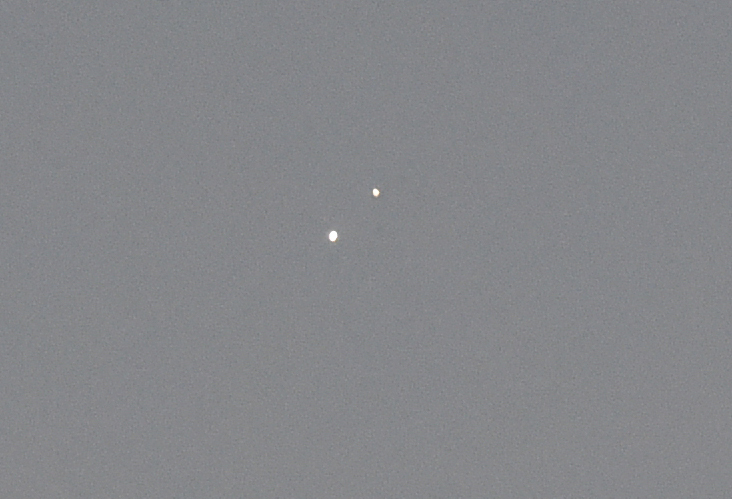
The Great Conjunction of Jupiter and Saturn.
— Meer Husamuddin (@HusamuddinMeer) December 21, 2020
(with the Galilean Moons of Jupiter)#jupitersaturnconjunction #thegreatconjunction
Shot on Canon Eos 200D at 250mm pic.twitter.com/DAHqlOScSn
The Great Conjunction of Jupiter and Saturn.
(with the Galilean Moons of Jupiter)#jupitersaturnconjunction #thegreatconjunction
Shot on Canon Eos 200D at 250mm pic.twitter.com/DAHqlOScSn
Here it is! The great conjunction as seen from Charlottesville just as clouds rolled in. Got some sunset light in there too – Pretty awesome event to see. #GreatConjunction pic.twitter.com/dCiCKnjs15
— Peter Forister 🍁🍂🍁 (@forecaster25) December 21, 2020
Here it is! The great conjunction as seen from Charlottesville just as clouds rolled in. Got some sunset light in there too – Pretty awesome event to see. #GreatConjunction pic.twitter.com/dCiCKnjs15
Planetary wanderlust
The last time Jupiter and Saturn crossed paths this closely was in 1623. The event wasn’t visible because the planetary passing occurred during daylight hours.
The world was quite different at that time. Three years earlier, the Pilgrims had disembarked at Plymouth Rock. Galileo Galilei, the famed Italian astronomer, had discovered Jupiter’s satellites just 13 years earlier.
People can pay homage to Galileo by observing this conjunction with a pair of binoculars, if not a telescope. The optics in a pair of binocs are “probably about as good” as the telescope Galileo used to discover Jupiter’s moons, Cuzzi says.
Before the 1623 conjunction, the next best one—which was viewable, occurring at night—happened in 1226. At that time, the Mongolian conqueror Genghis Khan was leading his army on a warpath across Asia.
Nice night for a planetary conjunction! Here’s my iPhone shot of the #GreatConjunction: bright Jupiter in the middle of the photo and slightly dimmer Saturn just above and to the right of it, almost touching! pic.twitter.com/Wa67PByNWI
— Katie Mack (@AstroKatie) December 21, 2020
Nice night for a planetary conjunction! Here’s my iPhone shot of the #GreatConjunction: bright Jupiter in the middle of the photo and slightly dimmer Saturn just above and to the right of it, almost touching! pic.twitter.com/Wa67PByNWI
Jupiter and Saturn from @CinObservatory Clear skies, great #conjunction pic.twitter.com/ZUWGw1fmYi
— Dean Regas (@DeanRegas) December 21, 2020
Jupiter and Saturn from @CinObservatory Clear skies, great #conjunction pic.twitter.com/ZUWGw1fmYi
Planets passing in the night
It’s speculated that an earlier conjunction could have been the historical basis for the “Christmas star,” also known as “the star of Bethlehem,” in Christian mythology. In the New Testament’s Gospel of Matthew, three wise men, or Magi, are guided to the site of the Nativity by the star.
“There was a conjunction in 7 BC, kind of like this one, and there was another one with Jupiter and Venus in 2 or 3 BC,” Cuzzi notes. “These things were happening then, and it’s possible that they could have inspired a lot of these stories.”
People can appreciate conjunctions not just for the historical perspective but the scientific one, too. Planets like Jupiter and Saturn are “good examples of the hundreds and hundreds of planets we are now discovering around other stars in our galaxy,” Cuzzi says, referring to the recent explosion of activity in so-called exoplanet hunting.
“We learn about these planets by studying our own,” Cuzzi says.
Tonight:
— NASA (@NASA) December 21, 2020
🌌 Find a spot with an unobstructed view of the sky
👀 Look southwest an hour after sunset
🪐 Spot the "Great Conjunction" of Jupiter and Saturn!
Why the two planets appear so close together: https://t.co/mX8x8YIlye pic.twitter.com/BMV3uMlJ6p
Tonight:
🌌 Find a spot with an unobstructed view of the sky
👀 Look southwest an hour after sunset
🪐 Spot the "Great Conjunction" of Jupiter and Saturn!
Why the two planets appear so close together: https://t.co/mX8x8YIlye pic.twitter.com/BMV3uMlJ6p