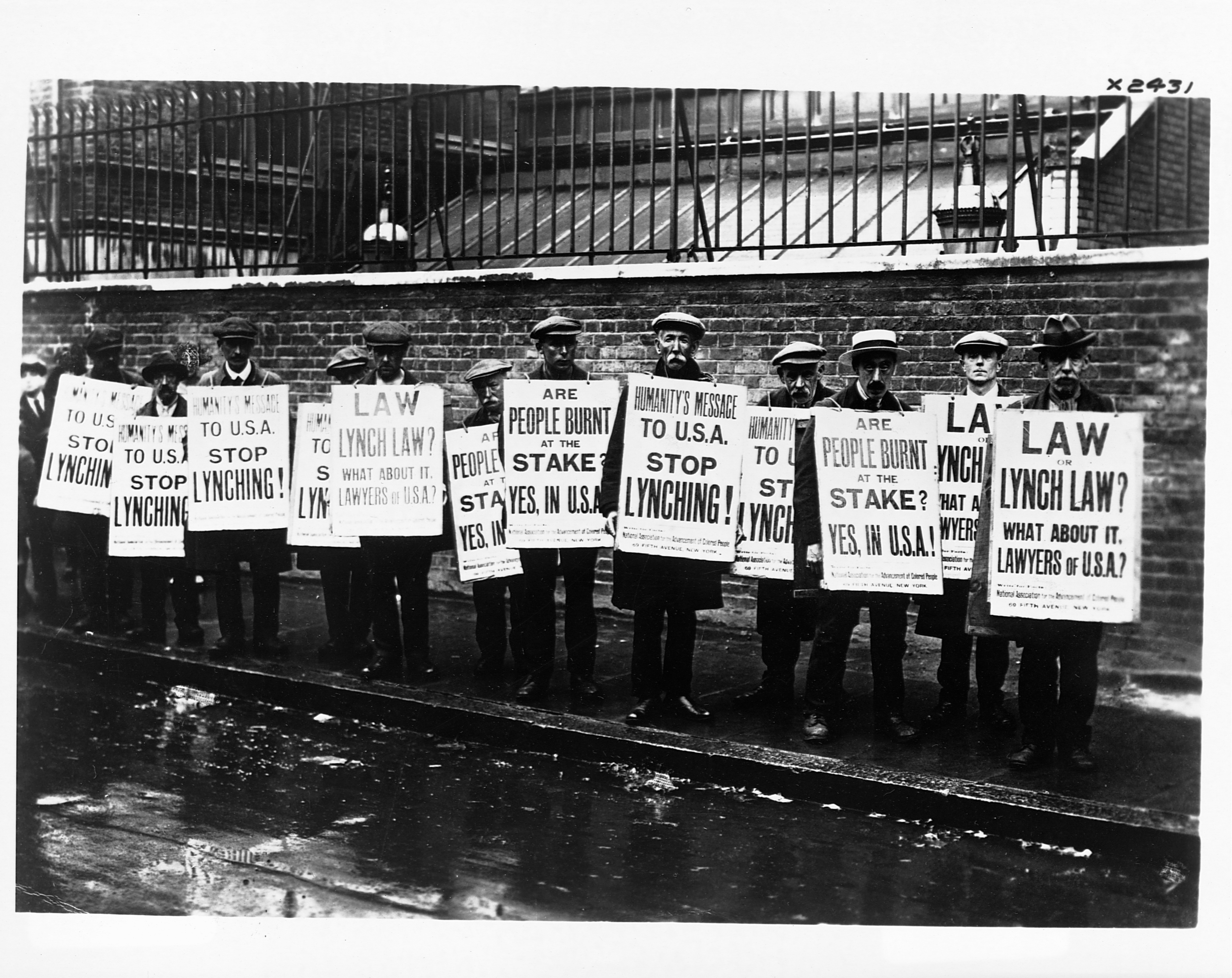
In a rare and welcome bit of bipartisan news yesterday, the Senate unanimously approved legislation making lynching a federal crime. The sponsors of the bill were two Democratic senators, Cory Booker of New Jersey and Kamala Harris of California, and Republican Tim Scott of South Carolina.
According to the bill’s sponsors, there have been nearly 200 attempts to bring similar legislation forward over the past one hundred years.
Senator Kamala Harris posted this video of the moment of passage. “Madame President, I ask unanimous consent that the committee on the judiciary be discharged from further consideration of S.3178 and that the Senate proceed to its immediate consideration.” Her words were formal but her expression was jubilant.
The moment was made even more poignant when the video cuts to the woman presiding over the committee: Mississippi Senator Cindy Hyde-Smith, who was recently under fire for making a casual joke about attending a public hanging.
Lynching is an extraordinarily ugly part of our American legacy, and though this legislation is way too late, I welcome it.
Lynching was extra-legal and socially sanctioned. It had a form and ritual to it. White men, women, and families participated in the kidnapping and torture of black citizens, often with the full knowledge of law enforcement and other authorities. It was often accompanied by vandalism, razing, and the widespread destruction of black-owned property. It is a stain on our civic record that is specific and unique.
Federal protection now makes mob killings a hate crime, potentially punishable by life in prison.
I welcome this legislative milestone not because it offers any remedy for past misdeeds or guarantees deterrence for future ones, but because it is part of the reckoning of a great, national forgetting that has allowed the darkness of our racial caste system to operate as if it were light.
No marginalized group has the luxury of forgetting.
This victory belongs to so many people whose names we may never know, but plenty who we do, chiefly among them, attorney and advocate Bryan Stevenson and his many supporters, whose tireless work on The National Memorial for Peace And Justice have re-centered the story of Jim Crow violence on the victims of racial terror.
But the bill also belongs to Ida B. Wells, a tireless journalist and investigative reporter who was threatened with lynching herself when she wrote an editorial decrying mob violence in 1892. “[N]obody in this section of the country believes the old threadbare lie that Negro men rape white women.”
It caused a riot that forced her to relocate across the country.
Wells, later Wells-Barnett, became a tireless advocate for change and used data and investigative techniques to make the case that lynching was as much about the economic encroachment of black workers as anything else.
In 1909, she delivered a blistering, evidence-filled speech to the National Negro Conference calling for federal policies to protect black citizens.
“Why is mob murder permitted by a Christian nation? What is the cause of this awful slaughter?” she began. “The only certain remedy is an appeal to law. Lawbreakers must be made to know that human life is sacred and that every citizen of this country is first a citizen of the United States and secondly a citizen of the state in which he belongs.”
Now they know.
So it was impossible not to feel her presence when Sen. Harris stepped to the podium to present the bill for consideration, and even more so when Sen. Hyde-Smith looked around the chamber and delivered, with absolutely no fanfare, a decision one hundred years in the making. “The ayes do have it. The bill is amended as passed.”