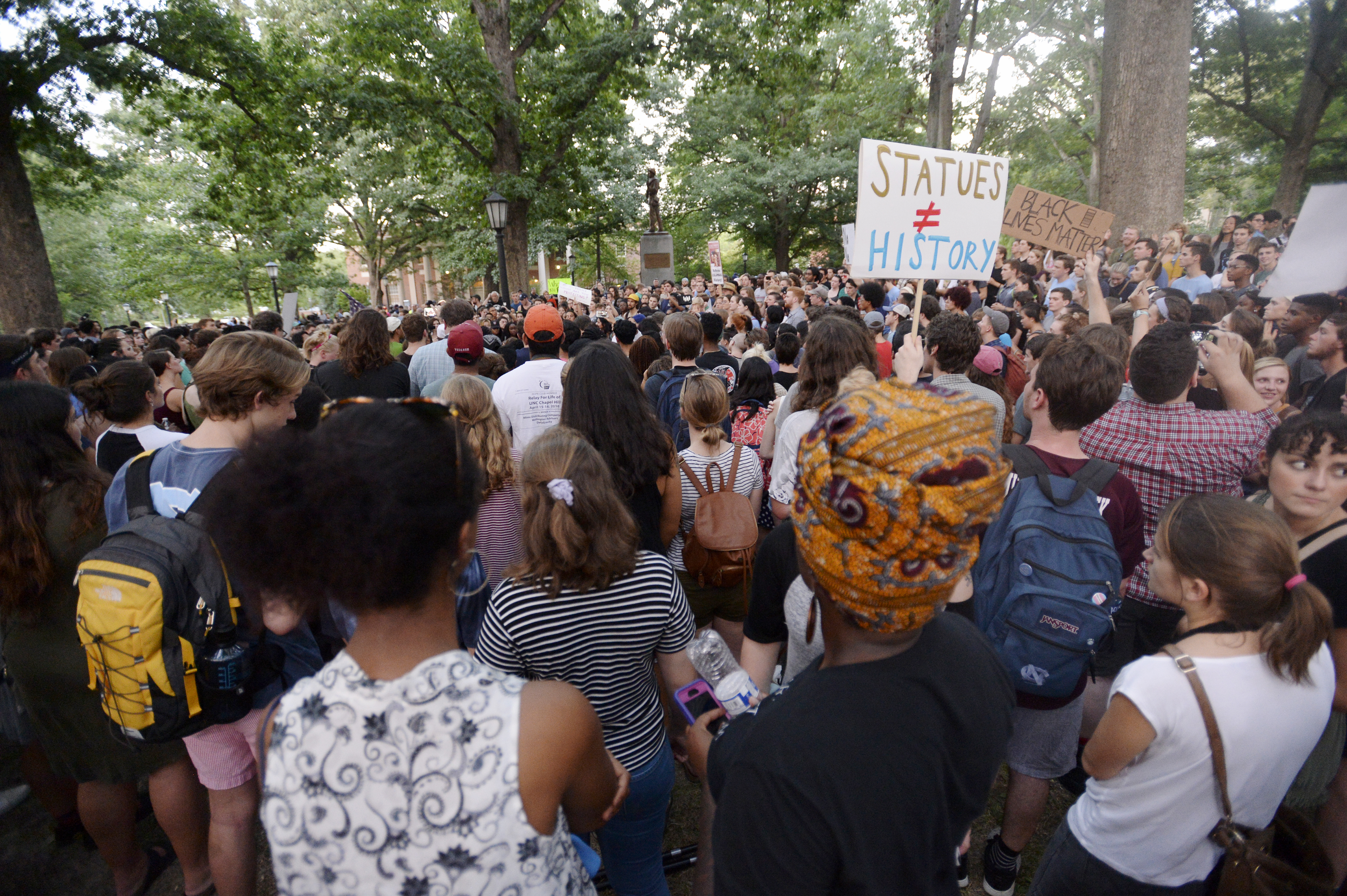
The controversial Confederate monument known as Silent Sam, which stood on the grounds of the University of North Carolina at Chapel Hill, was torn off its plinth by some 250 determined protestors last night. “Silent Sam is down,” tweeted The Daily Tarheel, the campus news outlet.
Classes begin today.
“I feel liberated — like I’m a part of something big. It’s literally my fourth day here,” first-year student Natalia Walker told The Daily Tarheel. “This is the biggest thing I’ve ever been a part of in my life just activist wise. All of these people coming together for this one sole purpose and actually getting it done was the best part.”
Carol L. Folt, the university chancellor, said in a statement today that the statue “has been divisive for years, and its presence has been a source of frustration for many people not only on our campus but throughout the community,” but noted that the actions of last night were “unlawful and dangerous.”
The dramatic toppling comes nearly a year after protestors pulled down a Confederate statue that stood in front of the Durham County Courthouse, in nearby Durham, North Carolina. That monument, dedicated in 1924 to “the boys who wore the gray”, was part of a wave of monuments erected with a single purpose: To enshrine white supremacy.
“The monuments that went up in the ’teens and 20s had a far more overtly political purpose,” James Leloudis, a professor of history at UNC-Chapel Hill, told The News and Observer last year.“If you look at the dedication addresses, speaker after speaker is very clear that those monuments are aimed at the rising generation of young North Carolinians who were coming of age, and who were born after the white supremacy struggles at the end of the 19th century. The funders and backers of these monuments are very explicit that they are requiring a political education and a legitimacy for the Jim Crow era and the right of white men to rule.”
The dedication address for the Silent Sam monument was delivered on June 2, 1913 by Julian Shakespeare Carr, a wealthy manufacturer and virulent racist from Durham. It was an eloquent tribute to white supremacy.
“The present generation … scarcely takes note of what the Confederate soldier meant to the welfare of the Anglo Saxon race during the four years immediately succeeding the war, when the facts are, that their courage and steadfastness saved the very life of the Anglo Saxon race in the South,” he began.
Young Carr had been but a private when the Confederate Army was defeated, but remembered the institution it fought for proudly:
I trust I may be pardoned for one allusion, howbeit it is rather personal. One hundred yards from where we stand, less than ninety days perhaps after my return from Appomattox, I horse-whipped a negro wench until her skirts hung in shreds, because upon the streets of this quiet village she had publicly insulted and maligned a Southern lady, and then rushed for protection to these University buildings where was stationed a garrison of 100 Federal soldiers. I performed the pleasing duty in the immediate presence of the entire garrison, and for thirty nights afterwards slept with a double-barrel shot gun under my head.
I trust I may be pardoned for one allusion, howbeit it is rather personal. One hundred yards from where we stand, less than ninety days perhaps after my return from Appomattox, I horse-whipped a negro wench until her skirts hung in shreds, because upon the streets of this quiet village she had publicly insulted and maligned a Southern lady, and then rushed for protection to these University buildings where was stationed a garrison of 100 Federal soldiers. I performed the pleasing duty in the immediate presence of the entire garrison, and for thirty nights afterwards slept with a double-barrel shot gun under my head.
Imagine saying that in a public square and expecting a warm response.
Then finally, this.
With pardonable pride I look upon the grand record of my Alma Mater, near whose confines I first beheld the light; in whose classic halls three of my sons have graduated and a fourth is now a student, and where my brother and three of his sons also matriculated. The glorious record of this seat of learning is embalmed in affections of our family.
With pardonable pride I look upon the grand record of my Alma Mater, near whose confines I first beheld the light; in whose classic halls three of my sons have graduated and a fourth is now a student, and where my brother and three of his sons also matriculated. The glorious record of this seat of learning is embalmed in affections of our family.
Embalmed, indeed.
The University now has to wrestle with the delicate issue of what to do with the fallen Sam and how to address the vandalism committed by protestors, made necessary in part by their own inaction. (The charges against the protestors in the Durham incident were dropped this past February, by the way.)
I wish them well in their deliberations. The reckoning around these latter-day monuments is an important part of the work that needs to happen now, in this instance, an opportunity provided by an angry throng. With a proper understanding of history and race, we can collectively come to terms with the tangled web of hate and oppression that have been long embalmed in many a treasured institution and public square.
Back in the day, Carr and his speech-making ilk failed to offer messages of equality and reconciliation. It’s not too late for the rest of us.