This article originally appeared on Money.com.
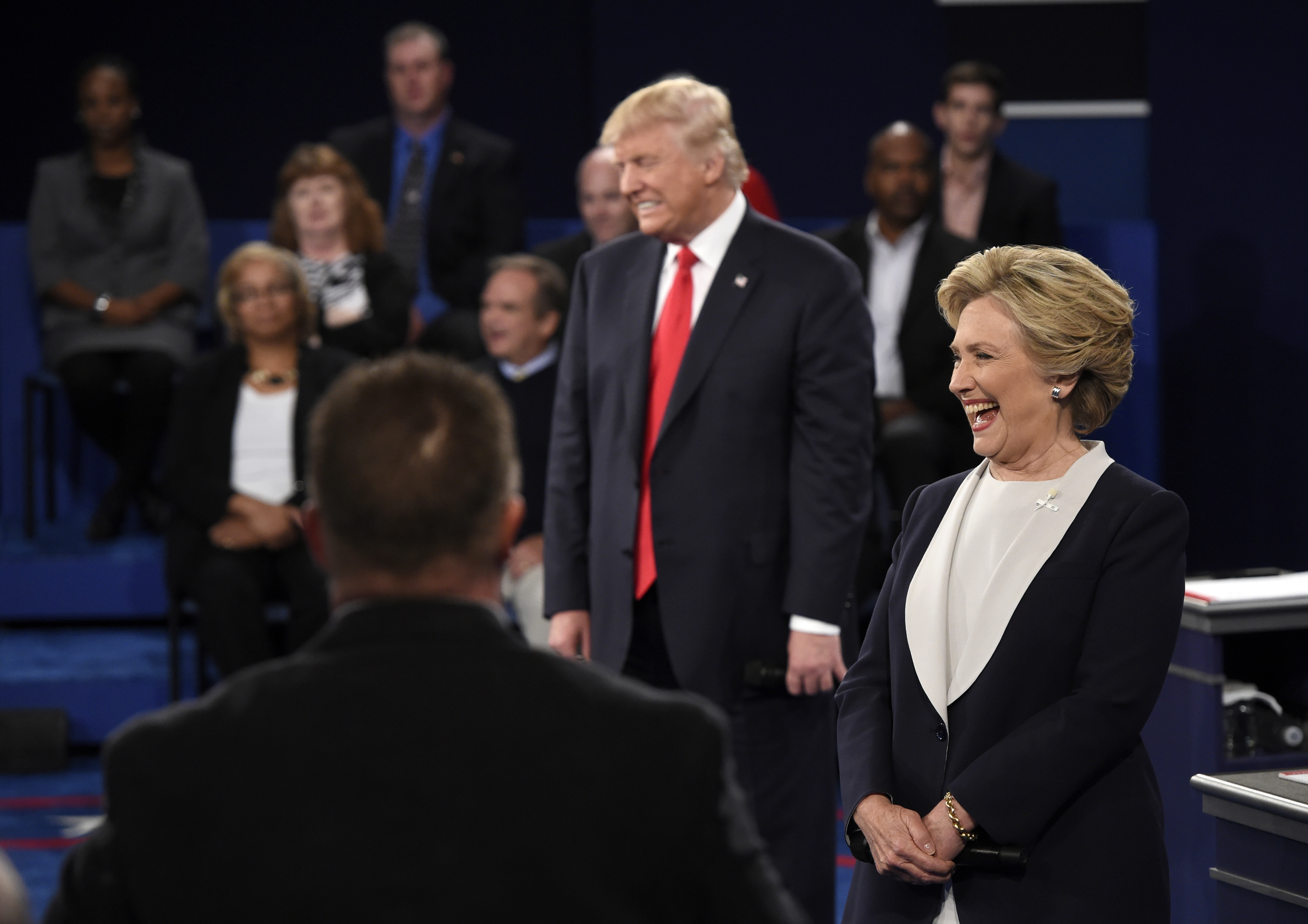
Obamacare, taxes, and the overall economy were central to the second 2016 presidential debate, held Sunday night in St. Louis.
As was the case at the first presidential debate and the vice-presidential debate, economists and economic pundits live-tweeted the town-hall-style discussion.
And as was the case at the first debate between Republican candidate Donald Trump and Democratic candidate Hillary Clinton, the target of most of that fact-checking was Trump.
Here’s a roundup of the highlights:
Commenting on U.S. economic conditions, Trump said, “Last year, we had almost $800 billion trade deficit.” That drew a response from Jared Bernstein, former chief economist and economic adviser to Vice President Joe Biden:
Trump fact chk: US trade deficit in 2015 was ~$500bn, not ~$800bn (~$760bn was trade deficit in goods; $260bn surplus in services) #debate
— Jared Bernstein (@econjared) October 10, 2016
Trump fact chk: US trade deficit in 2015 was ~$500bn, not ~$800bn (~$760bn was trade deficit in goods; $260bn surplus in services) #debate
— Jared Bernstein (@econjared) October 10, 2016
The Affordable Care Act, more commonly known as Obamacare, was a hot topic, spurred on by one questioner’s comment, “Premiums have gone up. Deductibles have gone up. Copays have gone up. Prescriptions have gone up. And the coverage has gone down.”
Calling Obamacare “a disaster,” Trump said, “It’s going up at numbers that nobody’s ever seen worldwide. Nobody’s ever seen numbers like this for health care….It’s very bad, very bad health insurance. Far too expensive. And not only expensive for the person that has it, unbelievably expensive for our country. It’s going to be one of the biggest line items very shortly.”
Multiple commenters took issue with Trump’s statements, including the Committee for a Responsible Federal Budget, under its Twitter handle @FiscalFactCheck.
Exchange subsidies are substantial, but will not be close to the biggest line item in the budget #debate
— Fiscal FactCheck (@FiscalFactCheck) October 10, 2016
Exchange subsidies are substantial, but will not be close to the biggest line item in the budget #debate
— Fiscal FactCheck (@FiscalFactCheck) October 10, 2016
Tonight @RealDonaldTrump said Obamacare will be 1 of our biggest budget items. Not so. #debate pic.twitter.com/XhEygfdxyo
— Fiscal FactCheck (@FiscalFactCheck) October 10, 2016
Tonight @RealDonaldTrump said Obamacare will be 1 of our biggest budget items. Not so. #debate pic.twitter.com/XhEygfdxyo
— Fiscal FactCheck (@FiscalFactCheck) October 10, 2016
https://twitter.com/sarahkliff/status/785292132919762945
The Washington think tank Brookings Institution, among others, marshaled stats to argue that Obamacare was not the disaster Trump painted it to be:
Average premiums in the individual market dropped significantly under the ACA: https://t.co/FsHJo5uI3Y #debate pic.twitter.com/5d3tB5J0mz
— Brookings Econ (@BrookingsEcon) October 10, 2016
Average premiums in the individual market dropped significantly under the ACA: https://t.co/FsHJo5uI3Y #debate pic.twitter.com/5d3tB5J0mz
— Brookings Econ (@BrookingsEcon) October 10, 2016
US health care cost growth. https://t.co/H5s5OtSxvZ pic.twitter.com/KoBrg52XeL
— Harold Pollack (@haroldpollack) October 10, 2016
US health care cost growth. https://t.co/H5s5OtSxvZ pic.twitter.com/KoBrg52XeL
— Harold Pollack (@haroldpollack) October 10, 2016
Coverage has not gone down since #Obamacare, it's gone up; premium increases have varied. #debate
— Fiscal FactCheck (@FiscalFactCheck) October 10, 2016
Coverage has not gone down since #Obamacare, it's gone up; premium increases have varied. #debate
— Fiscal FactCheck (@FiscalFactCheck) October 10, 2016
FACT CHECK: Since Obamacare passed, the nation has gained more than 15 million private sector jobs. #debate pic.twitter.com/lU15LPAGWU
— Dan Diamond (@ddiamond) October 10, 2016
FACT CHECK: Since Obamacare passed, the nation has gained more than 15 million private sector jobs. #debate pic.twitter.com/lU15LPAGWU
— Dan Diamond (@ddiamond) October 10, 2016
Statistician Nate Silver’s FiveThirtyEight pointed out that the U.S.’s health care system was no paragon of economic health before Obamacare, either:
The cost of healthcare in America was higher than in any other country before Obamacare. #debate https://t.co/TtCIiZQVjr
— FiveThirtyEight (@FiveThirtyEight) October 10, 2016
The cost of healthcare in America was higher than in any other country before Obamacare. #debate https://t.co/TtCIiZQVjr
— FiveThirtyEight (@FiveThirtyEight) October 10, 2016
As for Trump’s plan to get rid of Obamacare and start over, skepticism reigned. Jared Bernstein objected to the use of block grants, which Trump said he’d use:
Trump: Block granting Medicaid undermines it, especially in recessions (block granting kills countercyclical function) #debates
— Jared Bernstein (@econjared) October 10, 2016
Trump: Block granting Medicaid undermines it, especially in recessions (block granting kills countercyclical function) #debates
— Jared Bernstein (@econjared) October 10, 2016
The American Enterprise Institute’s James Pethokoukis linked to an article arguing that another of Trump’s strategies for lowering health care costs, permitting sale of insurance across state lines, was unlikely to significantly reduce the cost of health insurance.
The pros and cons of selling health insurance across state lines https://t.co/Uzzr2vrE31
— James Pethokoukis ⏩️⤴️ (@JimPethokoukis) October 10, 2016
The pros and cons of selling health insurance across state lines https://t.co/Uzzr2vrE31
— James Pethokoukis ⏩️⤴️ (@JimPethokoukis) October 10, 2016
The Committee for a Responsible Federal Budget estimated the impact of such a move on coverage:
We estimated that Trump’s healthcare plan to repeal and replace #Obamacare would reduce coverage by 20 million. https://t.co/RdIGWg5iSj
— CRFB.org (@BudgetHawks) October 10, 2016
We estimated that Trump’s healthcare plan to repeal and replace #Obamacare would reduce coverage by 20 million. https://t.co/RdIGWg5iSj
— CRFB.org (@BudgetHawks) October 10, 2016
Adam Brandon, president of FreedomWorks, was dismissive of Obamacare, as was the free-market advocacy group Club for Growth:
#Obamacare is a wreck and beyond fixing #debate https://t.co/wBorT6lbkW
— Adam Brandon (@adam_brandon) October 10, 2016
#Obamacare is a wreck and beyond fixing #debate https://t.co/wBorT6lbkW
— Adam Brandon (@adam_brandon) October 10, 2016
America knows the Affordable Care Act is anything but affordable!
— Club for Growth (@club4growth) October 10, 2016
America knows the Affordable Care Act is anything but affordable!
— Club for Growth (@club4growth) October 10, 2016
On the subject of taxes and tax plans, Trump characterized U.S. taxes as “just about the highest in the world.”
Not so, said, Len Burman, director of the Tax Policy Center:
US taxes are very low by international standards. #debate pic.twitter.com/uZbebzJFdb
— Len Burman (@lenburman) October 10, 2016
US taxes are very low by international standards. #debate pic.twitter.com/uZbebzJFdb
— Len Burman (@lenburman) October 10, 2016
Trump said his plan would cut taxes for everyday Americans, while Clinton’s would raise them: “We’re cutting taxes for the middle class. And I will tell you, we are cutting them big league for the middle class. And I will tell you, Hillary Clinton is raising your taxes, folks….She’s raising your taxes really high.”
Not so, say economists, including Lily Batchelder, former deputy director of the White House National Economic Council:
Estimated conservatively, Trump would raise taxes on 25M adults and children in primarily low- and middle-income famiiles. pic.twitter.com/0hSWyFjdHM
— Lily Batchelder (@lilybatch) October 10, 2016
Estimated conservatively, Trump would raise taxes on 25M adults and children in primarily low- and middle-income famiiles. pic.twitter.com/0hSWyFjdHM
— Lily Batchelder (@lilybatch) October 10, 2016
Trump’s (and Clinton’s) plan to tax carried interest in an effort to capture profit-taking by hedge fund managers wouldn’t have much of an impact, said commenters such as Megan McArdle of Bloomberg View:
Donald Trump’s plan to make the tax code fairer: eliminate the carried interest. Amount of money this would raise: 0.05% of federal budget.
— Megan McArdle (@asymmetricinfo) October 10, 2016
Donald Trump’s plan to make the tax code fairer: eliminate the carried interest. Amount of money this would raise: 0.05% of federal budget.
— Megan McArdle (@asymmetricinfo) October 10, 2016
Commenters such as Justin Wolfers of the University of Michigan also disputed Trump’s characterization of the U.S. economy:
Ummm, except for the facts…
RT @realDonaldTrump Our country has the slowest growth since 1929. #BigLeagueTruth #debate pic.twitter.com/Mr3hwXtFU0— Justin Wolfers (@JustinWolfers) October 10, 2016
Ummm, except for the facts…
RT @realDonaldTrump Our country has the slowest growth since 1929. #BigLeagueTruth #debate pic.twitter.com/Mr3hwXtFU0
— Justin Wolfers (@JustinWolfers) October 10, 2016
Trump is totally wrong — or just plain lying — when he says job growth is a disaster under President Obama.
(chart from @JustinWolfers) pic.twitter.com/ygnNzjlE77
— Steven Greenhouse (@greenhousenyt) October 10, 2016
Trump is totally wrong — or just plain lying — when he says job growth is a disaster under President Obama.
(chart from @JustinWolfers) pic.twitter.com/ygnNzjlE77
— Steven Greenhouse (@greenhousenyt) October 10, 2016
But back to taxes: The last word came from author J.K. Rowling:
'It's your fault I didn't pay taxes, Hillary. Women let you do anything when you're a star.'
— J.K. Rowling (@jk_rowling) October 10, 2016
'It's your fault I didn't pay taxes, Hillary. Women let you do anything when you're a star.'
— J.K. Rowling (@jk_rowling) October 10, 2016
(Transcript excerpts from The Washington Post)